
















Current price of 1 bitcoin
The price of 1 bitcoin right now is $6,100. You can buy bitcoins or fractions of bitcoin easily, quickly and securely, from 20 euros up to 1 million euros, on Bit2me. It will only take you a few minutes.
This way you will have access to bitcoin, a digital currency that is transforming the world. After all, bitcoin is a currency that lets you do things no other currency can. Investing in Bitcoin is as simple as buying bitcoins. Making money with Bitcoin means buying bitcoins at one price and selling them when their price is higher. With Bit2Me you can buy and sell bitcoins and many of the most popular cryptocurrencies.
We also explain in detail how Bitcoin works
How is the price of a BTC determined?
If you had bought €100 worth of bitcoins in January 2010 and sold them in November 2013, their value would have been €120,000,000. Not bad at all, right? Going from €100 to 120 million euros in just 3 years. And all with a laughably small investment; it sounds like a dream. But the truth is that with Bitcoin and its price rallies, it is possible. In fact, in 2017 bitcoin reached its all-time high of almost $20,000 USD.
Now, you are probably wondering: how is the price of BTC determined so that situations like this can happen? Not only did it happen, and there is an explanation for it, but many believe a similar situation is yet to come.
Welcome to a new chapter of the Bit2Me Bitcoin Guide. Below we will help you understand everything related to the price of BTC, as well as the factors that determine it.
As we have already explained, Bitcoin is a distributed financial system, released in 2009 by a programmer under the pseudonym Satoshi Nakamoto. It is not issued by any government or company (although it is increasingly backed by them) and to date it is not considered legal tender in any country (although it is starting to fit into existing legal frameworks, such as the recent ruling declaring Bitcoin exempt from VAT throughout Europe).
Bitcoin is powerful and a masterpiece of engineering (or, as Bill Gates says of it: “a technological tour de force”). But how much is a bitcoin worth? Why does its price rise and fall so many times a day? Who determines its price? How secure is that price? Is it a scam, a Ponzi scheme or some strange mechanism to steal my money?
Bitcoin as money
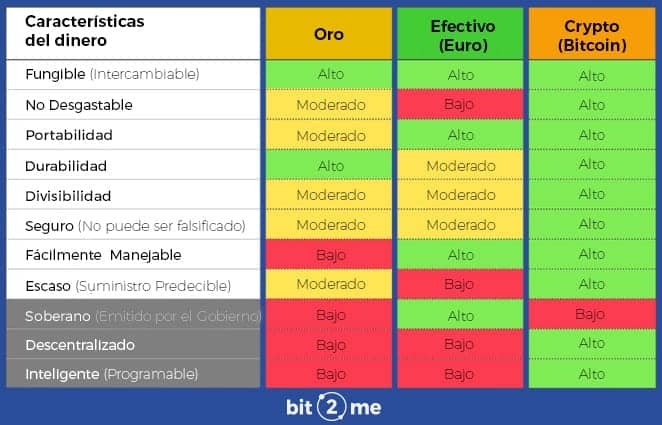
As we all know, money is whatever is accepted as a means of payment for a good or service. Good money is expected to serve as a unit of account and a store of value, among other characteristics.
But… wait a moment! If a money is not accepted as a means of payment, no matter how great it is as a unit of account and everything else… is it worth anything? That is why the value of money is not just loosely linked to its acceptance, but directly related to it.
Fiat money (official money such as euros or dollars, among others), as we know it today, is nothing more than banknotes and coins with no intrinsic value, far removed from the days when they represented a value in gold. They are backed and certified solely by issuing entities.
Currently it is governments, through imposed laws, that determine which type of money is legal tender. But it is other entities, such as central banks and mints (CECA), that take care of everything. First, regulating and controlling an economy’s monetary policy. Second, creating coins and banknotes according to demand and the need for physical and electronic money. They can create as much as they want, whenever they want.
No matter which period of history you pick, this model has proven to fail spectacularly. In the 21st century alone (and note that we are only a few years into it) there have already been multiple failures: crises, bank freezes, runaway inflation, …
Currencies issued by central banks are necessary for them to apply specific economic policies in an opaque way. This leaves the fate of millions of people at the whim of a few. Literally with the click of a mouse, they can generate new millions of euros on a computer that devalue people’s purchasing power.
Paradoxically, most of us see today’s money (euros, dollars, …) as a solution. But the reality is that it is something like a yoke that subjects us to the wishes of a few, while making us participants in wars and boundless atrocities time and again.
As we have already explained, Bitcoin has better properties than FIAT money (or fiduciary money, issued by governments). With Bitcoin and other virtual currencies or cryptocurrencies, this is impossible, because issuance control is decentralized and no one controls it.
Supply and demand
But who determines its price? The price of a bitcoin (BTC) is determined by anyone who wants to take part in the buying and selling process, essentially its users. Although multiple factors come into play, ultimately this is always what determines its price. Trading bitcoins allows them to be distributed and for people to profit from it. As in other scenarios, producers (in Bitcoin’s case, the miners) can propose a price when selling their bitcoins to interested parties, reaching agreements. Imagine the typical deal between two people: one proposes a price and if the other, after some haggling, is willing to accept it, the transaction goes ahead.
This can be done on the street, and it is. But in a computerized world like ours, it is more common to see these kinds of deals on specialized online platforms optimized for this purpose: the well-known “Bitcoin trading platforms”. There are dozens: OkCoin, Kraken and Poloniex are some of them.
Unlike a buy-and-sell website with set prices, such as Bit2Me, on a trading platform anyone can post a buy offer at their desired price.
In trading markets you are also not required to buy a whole bitcoin; you can buy fractions. Remember that 1 bitcoin is made up of 100 million “cents” (satoshis). If one Bitcoin is worth €1,000, you can buy 1 euro’s worth if you wish.
When a sell offer matches yours, the transaction is executed automatically. This buy-sell operation causes the price of bitcoin, on that platform only, to be set at the price of the trade that took place.
What we have just described is the same process by which all existing commodities are traded. And it happens dozens, hundreds or thousands of times a day, sometimes with large swings.
These kinds of operations require a minimum of research and prior work which, although free, not all users are willing to do.
For many users this side of Bitcoin is unappealing and even off-putting, since it seems to contribute nothing and most of the time is simple speculation: buy low and sell high. But the truth is that this model is helping Bitcoin spread and reach more places.
The value of bitcoin has changed over time and is based, roughly speaking, on the trust of its users, its usefulness and its popularity.
This means that, in 2010, the value of a bitcoin was less than one euro cent, since many still doubted its security, efficiency and, ultimately, its acceptance.
This way of determining price through buying and selling is no different from what happens in other sectors: fiat currencies (Forex), commodities, bonds, … But in Bitcoin it serves a dual purpose since, being something digital, it has at the same time been key to its spread, bringing bitcoins to more people.
The value of a bitcoin, like anything you can imagine, fluctuates every second. And I repeat, like anything. Do you think the value of the euro, or any currency, is stable? Go to a Forex market and see for yourself: its price changes every instant, and the same goes for everything: stocks, metals… even tomatoes! We live in a dynamic world; everything goes up and down every second, even if you don’t notice or it doesn’t get as much media attention.
There is plenty of room to grow. What would happen to the price of Bitcoin if Amazon decided tomorrow to accept it as a means of payment? No one knows what will happen, or even whether it will happen, but it may well happen, just as with thousands of large companies, countries…The price of a #bitcoin is determined by its community through supply and demand. #blockchain #fintech
There is no official or single bitcoin price
Having explained the above, you will understand that since there is no single platform in the world on which to trade (there are many, and each can have its own trades), there is no global or single bitcoin price.
Nevertheless, prices tend to converge. When there are very large price differences between two exchanges, some people take advantage of this gap to buy on the cheaper exchange and sell on the more expensive one. This, which is done every day, is known as arbitrage, and it results in prices evening out across the different exchange platforms within just minutes.
However, this does not happen everywhere, especially in places where access is very complicated. For example, in Africa, where it is harder to access bitcoins, local users may trade them at a price very different from Europe’s and still find it attractive, because at that price it is useful to the local community.
Bitcoin as a means of payment
A curious thing about Bitcoin, despite its source code not having changed much since its inception, is that it went unnoticed for a long time. Moreover, the few who paid attention to it did not take it seriously enough as a solid alternative to the traditional financial system.
For more than a year a bitcoin was worth absolutely nothing. It was a currency that very few users, entirely curious people or visionaries, sent each other as a reward for useful or funny answers on forums.
The first bitcoin price in history came about on May 22, 2010. This was on the BitcoinTalk forum, where the user jercos decided to buy two pizzas with his credit card for the user Laszlo in exchange for 10,000 bitcoins, possibly at an exchange rate of 1BTC = $0.003.
This simple event was the spark that ignited a rapid process of appreciation. The bitcoin holders of the time realized that they could access goods or services with their cryptocurrencies, which until then had no economic value, making it clear that Bitcoin definitely did have the capacity to become what its ideologue and creator, Satoshi Nakamoto, had proposed: an alternative and improved global financial system.
This led many people to sell bitcoins that previously had no value for a few euros. Just imagine! You have 10,000 bitcoins that you got for free or for one euro, and suddenly you can get €100 for all of them. Without being a fortune teller, what would you do?
Only a few visionaries (or, most likely, mostly absent-minded people) found themselves in situations like those of 2013, with millions of euros in their hands or trying to find a computer with thousands of bitcoins that they had thrown in the trash by mistake. Even so, 2013 was a year of many new millionaires thanks to Bitcoin.On May 22, 2010, #Bitcoin was born as a means of payment: 2 pizzas for 10,000 #bitcoins
Bitcoin price history
Ten years after its creation, Bitcoin is also characterized by its high volatility. Over its short but intense existence, a single bitcoin has gone from being worth literally nothing to almost 20,000 US dollars. Exchanges or cryptocurrency markets can show us a very detailed history of how the BTC/USD pair has evolved over all this time. All this information can help us choose the best time to invest in bitcoin.Don’t miss the evolution of Bitcoin’s price organized by milestones
Bitcoin price history.
Halving
As we explained in the article What is bitcoin mining?, in Bitcoin new bitcoins appear as a reward for miners. The reward, set out in Bitcoin’s open-source code, is cut in half every 210,000 blocks, roughly every 4 years, given that a block is mined every 10 minutes on average.
This event of cutting the reward in half roughly every 4 years is known as the Halving. Every bitcoin in existence was first owned by a miner, and this is how the 21 million bitcoins that will ever exist are gradually released.
Some believe that after a halving the price of bitcoin in the markets rises due to the cause-and-effect it generates in the ecosystem.
Want to know more about the “halving”?
It is one of the most important events in Bitcoin and you can learn more by reading the following article:
Bitcoin Halving.
External events
In a supply and demand system, every internal and external event has an effect on the price. Many positive and negative events have occurred in Bitcoin; for example, one of the most dramatic was the case of MT. Gox, which to this day remains unresolved: the largest and most famous Bitcoin exchange, MT. Gox, displayed a blank page on its website on February 24, 2014, leaving a debt of more than 850,000 bitcoins to its users, worth more than 450 million US dollars at the time.
These events involving cryptocurrency fraud and theft on specialized markets leave their mark on traders, and consequently on the price of bitcoin, usually in proportion to the media coverage of the event.
These events, which have little to do with Bitcoin and its technology, affect its reputation, especially when the media, consciously or unconsciously, link them to flaws in Bitcoin without explaining in detail what happened.
Miners
What do miners have to say about the price of bitcoin? Of course, they are an essential part of the ecosystem, and their general stance can also push the price up or down to a greater or lesser extent. Rather than setting prices, they usually feel the consequences; you only need to look at the map of active nodes to see how nodes disappear when the bitcoin price is low. Many of them simply disappear because the reward is not enough to cover costs and make a profit.
Miners are tied to the price by pure logic. The price of each Bitcoin is represented by its mining value. But its mining value is not always the same. Due to the dynamic difficulty of Bitcoin mining, it can cost more or less depending on the competition. Mining consumes a lot of electricity, and that consumption has a cost. So if demand suddenly soars, mining will be so profitable that many other miners will want to make money, and by starting to mine they raise the mining difficulty, so the cost will once again approach what people are willing to pay for each bitcoin, since otherwise it would not be profitable.
This model creates a tug-of-war that ensures the price of Bitcoin is always backed by its mining cost, which is why bitcoin has intrinsic value and is not FIAT.
Bitcoin stands out for having, and this is one of its greatest assets, the most powerful computing network on the planet. What would happen if a large share of mining nodes disappeared overnight? Would this affect its price?
Technically the network would readjust instantly and carry on as normal, but such an event would likely affect the price, at least because of the media buzz it would generate.
Halvings are curious events, since in theory they wipe out many miners at a stroke because the cost of mining no longer pays off, unless the price of bitcoin doubles.
But reality is not so simple. Of course miners want high prices, since they receive their rewards and fees in bitcoins, but on the other hand, without miners the Bitcoin network loses strength, which in turn, through a “butterfly effect”, causes the price of bitcoin to fall.
We must also remember that a Bitcoin transaction carries a fee, and miners can always decide which transactions to accept based on the fee. In terms of decisions and policies, they can determine the price of bitcoin.
Volatility
You are probably wondering how such a volatile currency can work. If there is one thing that characterizes Bitcoin and frightens people about it, it is exactly that: volatility. This is what drives Bitcoin’s price up, or down. It means that today I may have €100 and tomorrow €80 or €120. You are surely wondering: How can such a system be reliable?
It is very important to understand that Bitcoin was born in 2009. Every new means of exchanging value suffers volatility in its early years, and Bitcoin is no exception. Volatility stems from speculation. Every day thousands of people try to buy low and sell high. When someone buys and later sells, they are passing it on to other hands, which, repeated millions of times alongside media activity, brings millions of new users to it. This is exactly what is happening.
Something that at first seems absurd and pure speculation drives its spread, along with the joys and sorrows of speculative decisions on exchange platforms. Would Bitcoin have become so famous if people did not see it as an investment vehicle? It has many advantages, but for them to truly make sense it has to be a global system. To achieve this, it must go through years of expansion, one that will allow its users to enjoy its full potential. Let us remember that there is no multinational or government interested in forcing us to use it or shoving it down our throats with constant advertising to win users from whom they will later profit, which is why Bitcoin’s constant ups and downs seem, for now, to be working in favor of its expansion.
The future of the bitcoin price
It is not an easy task. There is little point in analyzing the current and historical price other than to observe a trend throughout its history.
Even though Bitcoin uses technology superior to that used by governments and banks, no one knows what may happen in the future. We do not know how technology, energy consumption… will evolve.
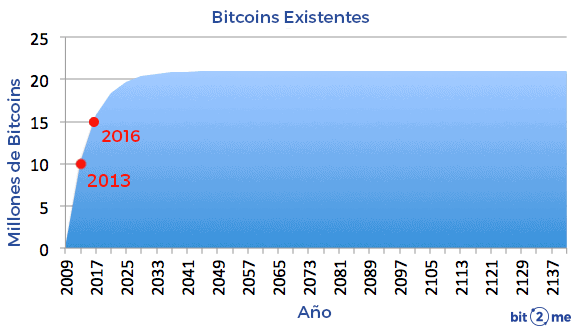
3 out of every 4 bitcoins that will ever exist are already on the market. Here you can see a real chart of how they have been issued and how many bitcoins are in circulation.3 out of every 4 #bitcoins that will ever exist are already on the market
And of those 3, estimates indicate that 3 out of every 4 bitcoins are being used as savings, as a store of value. On top of that, many have been locked away forever due to lost private keys. As a result, the number of bitcoins actually available for day-to-day use is even more limited.
While some predict Bitcoin’s failure, others predict exactly the opposite. Among them is Rickard Falkvinge, leader and founder of the Pirate Party, who argues that between 2020 and 2025 its price could be between 100,000 and 1,000,000 euros, or even more optimistic scenarios that put it at a value of 47 million euros per Bitcoin in the coming decades.In 2020/2025 the price of one #bitcoin could be between 100,000 and 1,000,000 euros. They also foresee its price stabilizing after the growth phase.
Bitcoin’s detractors argue that it could disappear at any moment. But how do you magically make something disappear that millions of people own and that gains new users exponentially every month? An open, transparent system, with some of the best minds on the planet working on it, many for the sheer pleasure of it: how do you stop that?
When you analyze Bitcoin over time, you see that it appears to be much stronger, fairer and more empowering for the user than even a country’s fiat money.
Let us remember that a bitcoin is divisible and has 100 million satoshis (its smallest unit), so a future could come where 1 satoshi equals 1 euro cent and a bitcoin is worth the million euros mentioned earlier. But beware! Bitcoin works by consensus, and the number of decimals could be increased if it ever became necessary and most nodes agreed.
Keep calm and relax
Either way, the price of BTC will end up being worth whatever people are willing to pay for it. As we have mentioned, Bitcoin is determined by the trust of its users, but also by supply and demand on the exchange markets.
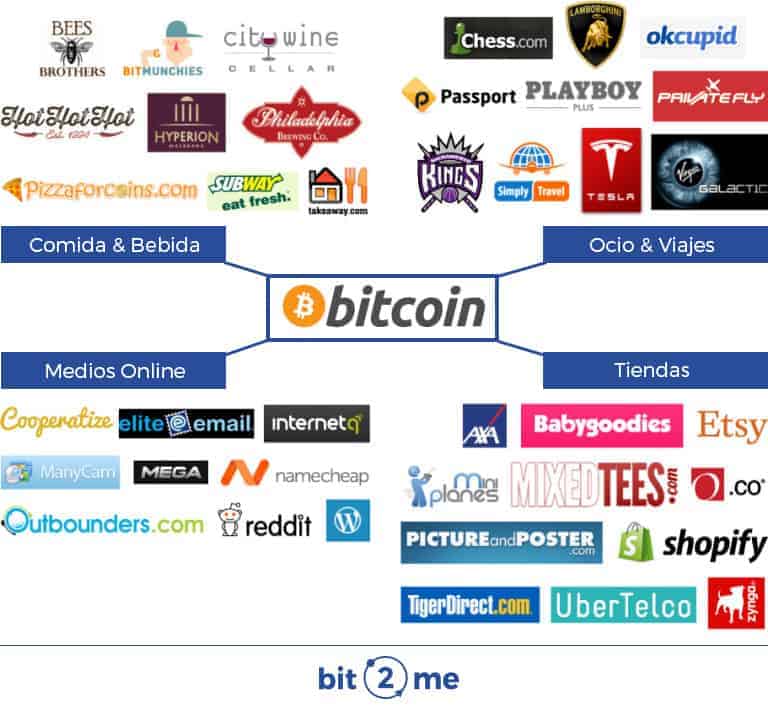
Currently hundreds of stores accept Bitcoin as a means of payment. You can see some of the most important ones here.
Do you think a system capable of managing global economic accounting in a more optimal, transparent, decentralized and cheaper way than the traditional one, and which gains millions of users every year, will disappear? And if it doesn’t disappear, how high do you think the price of a single BTC will go?
If you haven’t bought your first bitcoins yet, learn how to buy bitcoins here.
And, as always, don’t forget to share this chapter on social media. A new, fairer, cheaper and more equitable financial system has been born. Together we will make more people aware of it.























You must be logged in to post a comment.