
















David Chaum is a pioneer of cryptography applied to the digital medium. He was one of the first people to develop tools to protect privacy in the transfer of information and value.
He is one of the greatest cryptographers in the world and his name is David Lee Chaum. Chaum was born in 1955 in the United States. He earned a PhD in Computer Science and Business Administration from the University of California, Berkeley. Considered the father of digital money, Chaum has an extensive career as a professor, researcher and developer of cryptographic protocols.
A life dedicated to cryptography
He was a promoter and organizer of the first annual cryptography and cryptology conferences held in Santa Barbara (California) starting in 1982. This annual conference was called CRYPTO, and it brought together highly knowledgeable professionals in the field to present new developments.
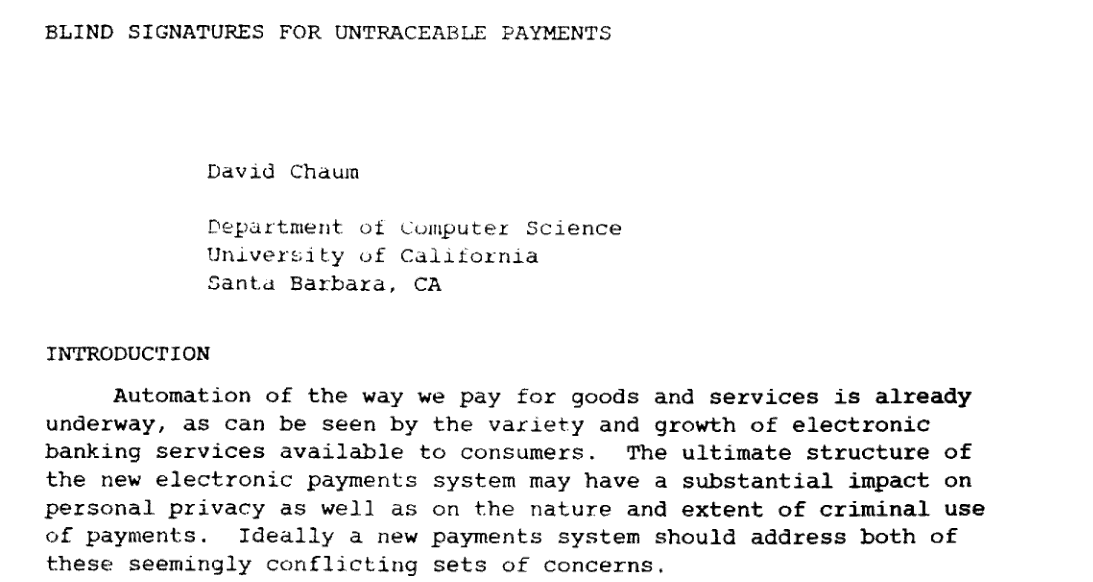
At the CRYPTO ’82 conference, David Chaum presented a paper that would become the seed of the first digital money protocol that could be truly anonymous. His proposal made it possible to create a cryptography-based digital payment system by introducing the concept of the blind signature.
*Read about blind signatures in Spanish on Wikipedia or blind signature in English on Bitcoin wiki
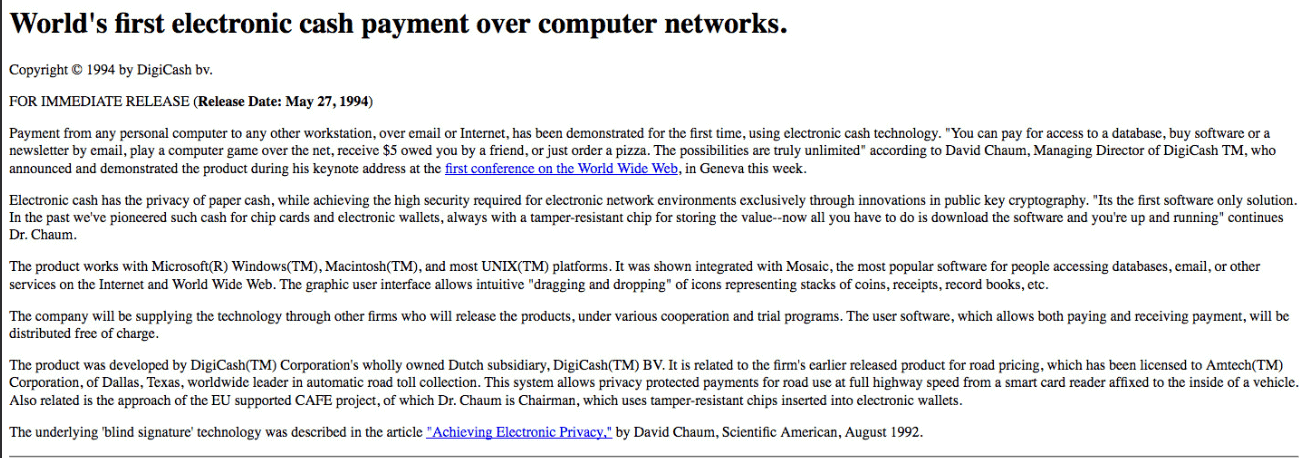
In 1990 David Chaum founded DigiCash Inc., a company to create electronic money services implementing his own research. With this company he developed eCash: an improved version of his own cryptographic digital payment system. During this time, Chaum worked with quite prominent cryptographers such as Eric Hughes and Nick Szabo, among others.
In 1994 the WWW94, the first conference on the World Wide Web, was held in Geneva, Switzerland. There, David Chaum announced and demonstrated, for the first time in the world, how eCash enabled electronic money payments over computers using only software.
Master of Masters
David Chaum has never stopped working, and after finishing his studies he founded the International Association for Cryptologic Research (IACR)
Likewise, he created a cryptography research group at the National Research Institute for Mathematics and Computer Science (CWI) in Amsterdam.
In addition, he has also been a professor at the Graduate School of Business Administration of the following universities: University of New York and University of California, Berkeley.
As a result of his contributions, David Chaum is also a reference figure for the people who started and promoted the Cypherpunk movement and culture. So much so that his name is cited more than 70 times in the ‘Cyphernomicon‘, a document published by Timothy May on September 10, 1994.
David Chaum – World Blockchain Forum 2018
Notable contributions to digital money
When reviewing David Chaum’s publications the conclusion is clear: the defense of privacy has been with him his whole life.
Below are some of his most notable contributions to the world of cryptography and digital money:
- Trustworthy voting system (1981) Chaum proposed a system for public elections with electronic voting. The original title is ‘Untraceable Electronic Mail, Return Addresses, and Digital Pseudonyms’
- Blind signatures for untraceable payments (1982) First approach to digital money through blind signature cryptography.
- Zero Knowledge Protocol (1988) in collaboration with Gilles Brassard and Claude Crepeau, they developed secure channels that allow transactions to be carried out without leaving traces of the sender, the receiver or what was sent.
- Untraceable Electronic Cash (1988) in collaboration with Amos Fiat and Moni Naor, implementation of offline transactions with a double-spending detection system.
- DigiCash (1990) An electronic cash company based in Amsterdam to commercialize the ideas from his research.
Elixxir & Praxxis, his own crypto projects
Finally, it is worth noting that today David Chaum is working on the development of his own cryptocurrency-related projects. The first of them is called Elixxir, and its proposal is based on a decentralized blockchain network for fast, secure and confidential messaging and payments. To find out how this project’s roadmap is progressing, we recommend following its official channels.
Praxxis is a project that proposes a quantum-resistant currency that will use the infrastructure created in Elixxir. In the words of its official website, Praxxis is a new high-performance digital currency backed by a quantum-resistant blockchain. Using denominated coins and a new approach to consensus, Praxxis harnesses the power of its sister Elixxir’s privacy-protecting platform.
























You must be logged in to post a comment.