
















The most enigmatic identity in the world of cryptocurrencies is that of Satoshi Nakamoto. A faceless pseudonym with nothing more than a series of emails that left behind one of the greatest and most important technological creations of humanity: Bitcoin and the blockchain. Learn everything we know so far about this person or group of people.
In the history of Bitcoin there is one question that has so far been impossible to answer and that people are trying to resolve by every means possible. That question is: Who is Satoshi Nakamoto?
The creator of the idea and developer of Bitcoin’s free software does not have a known face, since it is really a pseudonym. Initially, it was thought to be someone of Japanese descent. But over time, and following a disappearance as enigmatic as the appearance, all kinds of speculation have emerged.
During this time, several names of people or organizations have come up, pointed to with more or less conviction by various theories. Among the hypotheses put forward there is a bit of everything, from people claiming to be Nakamoto without providing any proof. There are even arguments that include conspiracies and aliens; for now, we will leave the latter aside.
The truth is that to date it is NOT known who, which people or what Satoshi Nakamoto is: the creator of Bitcoin and the seed of an entire technological revolution called Blockchain, which has turned upside down not only the financial sector, but almost every sector on the planet in search of environments without intermediaries, secure and transparent while also guaranteeing privacy.
In the first section we will present a series of events related to Satoshi Nakamoto to draw a timeline with the most relevant points. Next, we will look at the people who have stood out most in the search for Nakamoto. And finally, a group of names that have been pointed to, but who seem very unlikely to be him.
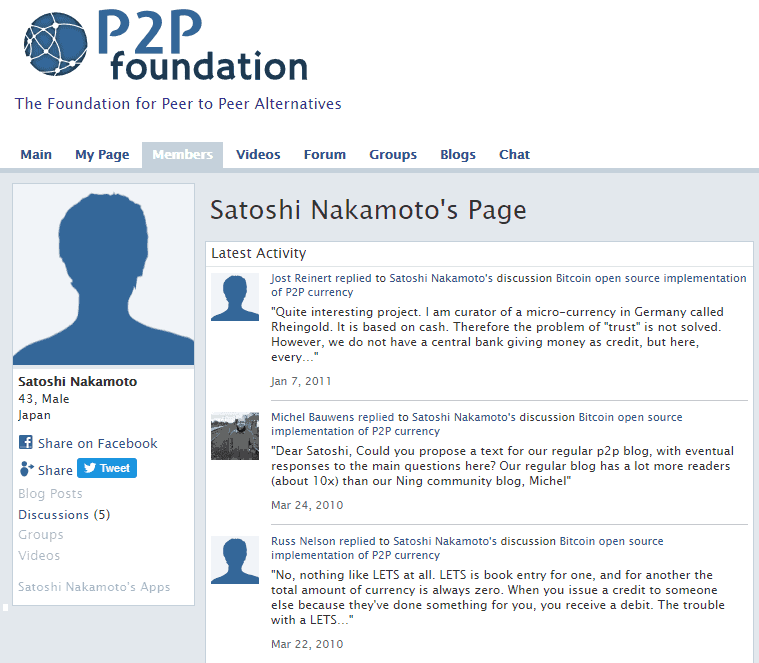
Satoshi Nakamoto’s profile on the P2P Foundation, where he states he is a 43-year-old Japanese man
Satoshi Nakamoto Timeline
In this first section we will focus on Nakamoto’s most relevant appearances. We will go from his first public communication until he disappeared without warning.
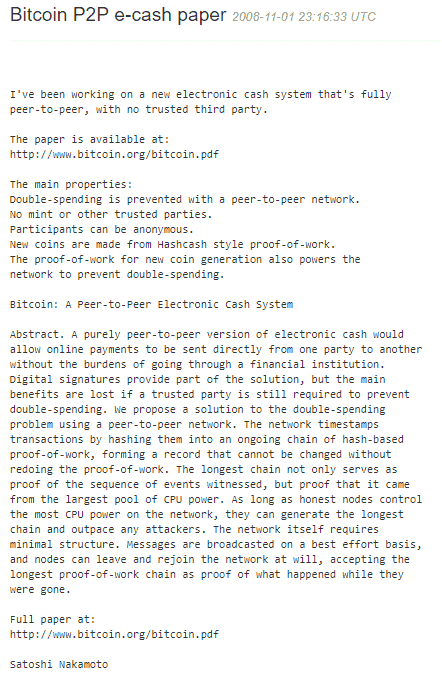
- Friday, 10/31/2008: Satoshi Nakamoto talks about Bitcoin for the first time on the Metzdown.com cryptography mailing list, publishing his whitepaper
- Monday, 11/17/2008: In one of Nakamoto’s messages on the cryptography mailing list, he replies to James A. Donald, stating that he has been developing Bitcoin for a year and a half
- Friday, 01/09/2009: Satoshi Nakamoto uploads version 0.1 of the Bitcoin software
- Saturday, 01/10/2009: Hal Finney, the first Bitcoin user after Satoshi Nakamoto, posts the following message on his Twitter account: ‘Running Bitcoin’
- Monday, 01/12/2009: The first transaction in Bitcoin’s history takes place. Hal Finney receives 10 bitcoins from Satoshi Nakamoto in a test to check the network and make sure everything worked correctly
- Sunday, 11/22/2009: Nakamoto publishes the first message on the famous Bitcointalk forum, welcoming users
- Monday, 12/13/2010: Satoshi Nakamoto’s last post on Bitcointalk, where he announces the release of version 0.3.19 of the Bitcoin software
- Friday, 03/07/2014: Amid the public debate over a possible Satoshi Nakamoto (Dorian Nakamoto, whom we will discuss later), Satoshi Nakamoto published what would be his last message on the internet, saying “I am not Dorian Nakamoto“.
These are the most relevant points marking the beginning and end of Nakamoto’s presence to date. Within this timeline there were two relevant events, whose veracity we cannot fully confirm, that we want to highlight:
Tuesday, 04/26/2011
On that day Satoshi Nakamoto sent his last email to Gavin Andresen. In it, Nakamoto asks Andresen to stop talking about him ‘as a mysterious shadowy figure’ and urges him to emphasize that “it is an open source project and give more emphasis to the contributions of your collaborators”
Andresen replies to the email and explains that he has been contacted by IQT, a ‘strategic investment’ firm funded by the United States Government, in order to give a talk. He says he will post it on the forums to avoid the suspicion that ‘Gavin is secretly visiting the CIA’, sparking multiple conspiracy theories. Although he notes that saying ‘Gavin is openly visiting the CIA’ will also give rise to all sorts of conspiracies.
Nakamoto never replies to this email.
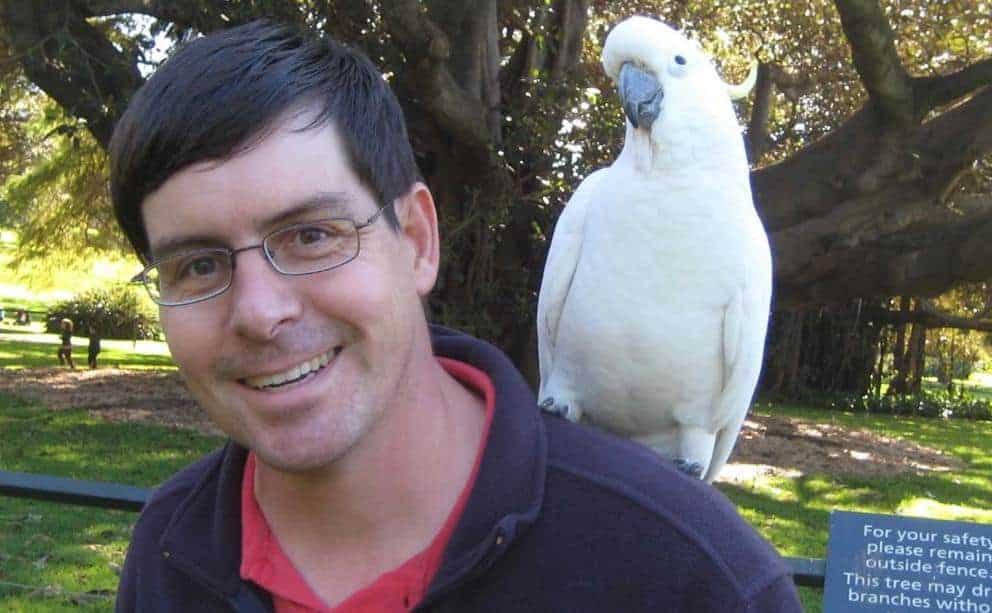
Gavin Andresen enjoying a day off with a friend
Friday, 03/07/2014
‘I am not Dorian Nakamoto’ With this brief comment on his own post ‘Bitcoin open source implementation of P2P currency’, published on February 11, 2009, he completely refutes the theories of the outlets Newsweek and Gizmodo, which claimed on March 6, 2014 that Dorian Prentice Satoshi Nakamoto could be the person who created Bitcoin.
Some believe that Nakamoto’s P2P Foundation account may have been hacked and that it was not really him who posted the message. The alleged hacker has never come forward. In the following days he claimed to have access to Nakamoto’s email account and to possess Nakamoto’s real identity, even asking for 25 bitcoins in exchange for the information. It was never made public, and we do not know whether the real Satoshi Nakamoto posted the message or whether it was an attacker.

Satoshi Nakamoto’s 2014 message denying he is Dorian Nakamoto
Main Candidates to Be Satoshi Nakamoto
Before going through the list of possible people behind the figure of Nakamoto, it is worth noting that the most likely scenario is that it is not a single individual, but rather a group of people connected to the world of computing, cryptography and the Cypherpunk movement.
Hal Finney
Without going deep into his professional or personal career, Finney (now deceased) is perhaps the strongest candidate to be Nakamoto because of some of his published texts. He was closely linked to the origins of the Cypherpunks in San Francisco and was passionate about cryptography and computer security. Before being associated with Bitcoin he published the following works:
- 08/19/1993: Digital Cash and Privacy
- 10/15/1993: Detecting Double Spending (revised 03/13/1996)
- 01/02/1994: Politics vs Technology
- 03/30/1994: PGP Web of Trust Misconceptions
- 08/15/2004: RPoW. Reusable Proof-of-Work
We can see that some of these works, especially the one published in 2004, have a lot to do with the foundations of Bitcoin. In fact, RPoW (which proposed improvements for systems implementing PoW, such as HashCash) could perfectly well be the basis of the proof of work used in Bitcoin today.

Hal Finney with his wife Fran before a race
Perhaps the most relevant fact is the tweet posted on January 10, 2009, a few hours after Nakamoto released version 0.1 of the Bitcoin software. On January 10 Finney posted on his Twitter account: ‘Running Bitcoin’, referring to the fact that he was already using the software.
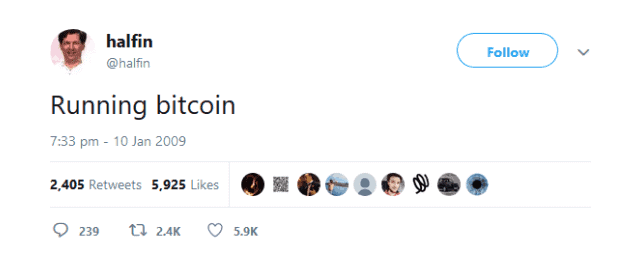
Hal Finney posts on Twitter that he has run the Bitcoin software a few hours after Nakamoto released it.
On January 12, 2009, just two days later, he receives 10 bitcoins from Nakamoto to test sending cryptocurrency. This would be the first recorded bitcoin transfer.
Right at the best moment of Finney’s life and career, he received the worst possible news. In August 2009 he was diagnosed with amyotrophic lateral sclerosis (ALS), a disease that damages the cells of the nervous system, gradually reducing their function until they die. Despite everything he kept working, saying that he was still programming, but that the task took him about 50 times more effort than before.
On March 19, 2013, Finney published a letter on the Bitcointalk forum called ‘Bitcoin and me’, in which he tells the whole story between himself and the cryptocurrency. In it he states that “I think I was the first person, after Satoshi, to run the Bitcoin client”
“Today, Satoshi’s true identity has become a mystery. But at the time, I thought I was dealing with a young man of Japanese ancestry who was very smart and sincere”
Not only that, Finney states that: “I feel incredibly lucky to have been there from the beginning”
A year later, on March 25, 2014, Andy Greenberg, a Forbes journalist, paid a visit to Finney, who was by then completely paralyzed by ALS, to talk about the possibility that he was Nakamoto. In the conversation they discussed matters such as his emails with Nakamoto and the history of his Bitcoin wallet. During the conversation Finney denied several times being Nakamoto, and according to Greenberg, she believes Finney told the truth.

Hal Finney, bedridden by ALS, assisted by his wife Fran, who never left his side
Greenberg also asked the writing analysis consultancy (analysis of writing style) Juola & Associates to compare Finney’s texts with Nakamoto’s, finding a significant resemblance.
Robin Hanson, Finney’s friend, former colleague and occasional co-blogger, stressed that “there is at least a 15% chance that Hal was more involved than he said”
On August 28, 2014, Hal Finney died of ALS. He is currently cryopreserved at Alcor, Arizona (United States)
Perhaps the last piece of the puzzle is Dorian Nakamoto, whom we discuss below, a physicist who studied at Cal Poly Pomona and who worked for the US defense agency, and as a computer engineer for technology and financial information companies. It so happens that Finney and Nakamoto lived very close to each other and there is a chance they knew each other, with Hal Finney adopting this physicist’s name as a decoy.
That Hal Finney could be the person (or one of the people) who created Bitcoin is only speculation so far; but what is certain and proven are his important contributions to the code from the very first moments of Bitcoin’s birth.
And he won’t be the only one…Could Hal Finney be the real identity of Satoshi Nakamoto?
Nick Szabo
The next candidate would be Nick Szabo, a prominent computer scientist, legal scholar and cryptographer who laid the foundations for Bitcoin without knowing it. He was the one who developed a theoretical mechanism for a decentralized digital currency called ‘Bit Gold’, which never materialized and remained theoretical, and he also developed the concept of ‘Smart Contracts’
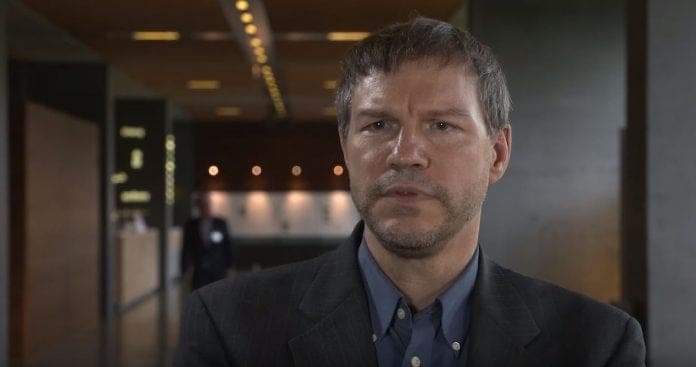
Nick Szabo laid the theoretical foundations of Smart Contracts
As we explained in detail in the Smart Contracts chapter, they were proposed in 1994 as an evolution of basic contract law with no intermediaries, physical documents or bureaucracy slowing the process down and making it costly. The idea was software that executed automatically and settled when its conditions were met, thereby releasing the assets or funds built into it.
It is worth noting that in 2018 the United States Senate said that:
“While smart contracts might sound new, the concept is rooted in basic contract law. Usually, the judicial system adjudicates contractual disputes and enforces terms, but it is also common to have another arbitration method, especially for international transactions. With smart contracts, a program enforces the contract built into the code”
It was in 1998 that Szabo proposed ‘Bit Gold’, a digital currency that required participants to use computing power to solve cryptographic puzzles. The solved puzzles would be sent to a registry called Byzantine Fault Tolerant (Byzantine Fault Tolerant) and the solver would be assigned a public key. Each solution would become part of the next challenge, creating a growing chain of ownership. This provided a method for the network to verify and timestamp new digital coins, where the majority of parties had to accept the solutions or the next puzzle could not begin.
With this background, in December 2013 blogger Skye Gray linked Szabo to the Bitcoin Whitepaper through stylometric analysis. We also know that Szabo had used other pseudonyms in the 90s. In May 2011 Szabo published a note regarding Nakamoto’s possible identity, stating verbatim:
“Myself, Wei Dai, and Hal Finney were the only people I know of who liked the idea enough to pursue it to any significant extent until Nakamoto (assuming Nakamoto is not really Finney or Dai). Only Finney (RPOW) and Nakamoto were motivated enough to actually implement such a scheme”
Dominic Frisby is a financial author who carried out significant research into the possibility that Szabo was Nakamoto, and concluded that there is no conclusive proof of this, only circumstantial evidence. Frisby, during an interview on the Kaiser Report on RT, stressed that: “I’ve concluded there is only one person in the whole world that has the sheer breadth but also the specificity of knowledge and it is this chap…”
In July 2014, Szabo wrote to Frisby to tell him: “Thanks for letting me know. I’m afraid you got it wrong doxing me as Satoshi, but I’m used to it”
New York Times journalist Nathaniel Popper stated that “the most convincing evidence pointed to a reclusive American man of Hungarian descent named Nick Szabo”
The Figures Who Laid the Foundations of Bitcoin
Although the two figures mentioned below are unlikely to actually be Satoshi Nakamoto, their work served as the basis for the development of Bitcoin, and it cannot be ruled out that they played a more relevant role in Bitcoin’s development than one might imagine or see at first glance.
Adam Back
Adam Back is a British cryptographer who describes himself as a ‘Cypherpunk‘. He developed the basis of proof of work: HashCash.
This solution, which was conceived as a system to prevent spam, is a key theoretical component of “Proof of Work (PoW)”, Bitcoin’s consensus algorithm.
HashCash basically consisted of a system that required anyone wanting to send an email or post on a blog or forum to perform a small computation (work); this created a mark (proof) on the email or comment indicating that it was not junk (spam)

Adam Back devised Hashcash to fight spam, and years later Satoshi Nakamoto adapted it for his decentralized digital currency
This work required processing power and time amounting to just a few seconds, but it prevented spammers from sending thousands of emails per minute, allowing them to send only a fraction of those emails and making their efforts pointless.
Although he is not considered the creator of Bitcoin, his work was essential to establishing the proof-of-work system on which this cryptocurrency is based. Back is also the CEO of Blockstream, a company whose mission is the development of Bitcoin and blockchain technology.
Wei Dai
Little is known about Wei Dai, computer engineer and Cypherpunk, beyond being the creator of b-money and developer of the Crypto++ library. He is not fond of public appearances and very little is known about him personally.

Wei Dai in his office in 2004. One of the few images of him that exist.
He graduated from the University of Washington with a degree in Computer Engineering. He is usually described as an ‘intensely private computer engineer’. His profile as a member of the advisory board of VoteHere.net (a now-defunct website) stated:
“Mr. Dai worked in the Cryptography Research Group at Microsoft Corporation in Redmond, Washington. While at Microsoft, he was involved in the study, design and implementation of cryptosystems for specialized applications. Prior to joining Microsoft, Mr. Dai was a programmer with TerraSciences of Acton, Massachusetts. Mr. Dai holds a Bachelor of Science from the University of Washington in Computer Science, with a minor in Mathematics”
It was in 1998 that he published ‘b-money, an anonymous, distributed electronic cash system’, laying the foundations of today’s crypto-economy. It describes the basis of modern cryptocurrencies: “a scheme for a group of untraceable digital pseudonyms to pay each other with money and to enforce contracts amongst themselves without outside help”
Wei Dai’s b-money idea is referenced in the original Bitcoin Whitepaper, forming the basis of the project. Although Dai questions b-money’s influence on Bitcoin: ‘My understanding is that the creator of Bitcoin, who goes by the name Satoshi Nakamoto, didn’t even read my article before reinventing the idea himself. He learned about it afterwards and credited me in his paper. So my connection with the project is quite limited.’
As a curiosity, it is worth noting that the smallest unit of Ether, the cryptocurrency of the Ethereum network, is called wei in honor of Wei Dai.
The Dorian Coincidence?
There are few definitive statements about the figure of Satoshi Nakamoto. But perhaps the most definitive is that Dorian Prentice Satoshi Nakamoto is not actually the same Satoshi Nakamoto who created Bitcoin.
Journalist Leah McGrath Goodman of Newsweek magazine published on March 6, 2014 the discovery of a man of Japanese origin living in California named Dorian Prentice Satoshi Nakamoto, whose birth name is Satoshi Nakamoto.
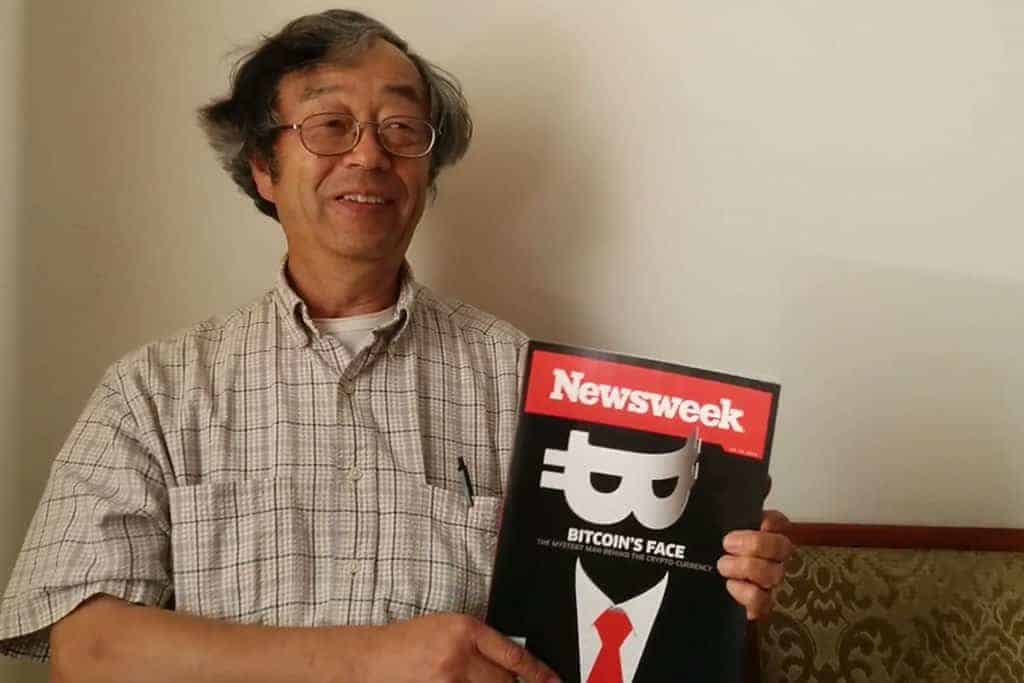
Dorian Nakamoto posing with the Newsweek magazine that suggests he is the one behind the pseudonym Satoshi Nakamoto
Goodman puts forward a series of arguments that led to the belief that he was the creator of Bitcoin. Dorian (we will call him that to distinguish him from the Satoshi Nakamoto who created Bitcoin) earned a degree in physics from Cal Poly Pomona. He also worked as a systems engineer on classified defense projects and as a computer engineer for technology services and financial information companies.
Dorian was laid off several times in the ’90s and became a libertarian, even encouraging his daughter to start her own business ‘not under the control of the government’
Goodman asks Dorian directly about the creation of Bitcoin in an interview, and Dorian seems to respond affirmatively but ambiguously as to whether he is the creator of the cryptocurrency:
“I am no longer involved in that and I cannot discuss it. It’s been turned over to other people. They are in charge of it now. I no longer have any connection.”
The article sparked the interest of the press, with hundreds of journalists camping at his door, and he was even pursued while driving in his daily life. To settle the matter, Dorian gave a later, rather extensive interview in which he denied any connection with Bitcoin, claimed he had never heard of it and said he had misinterpreted Goodman’s question, thinking it referred to his work as a military contractor.
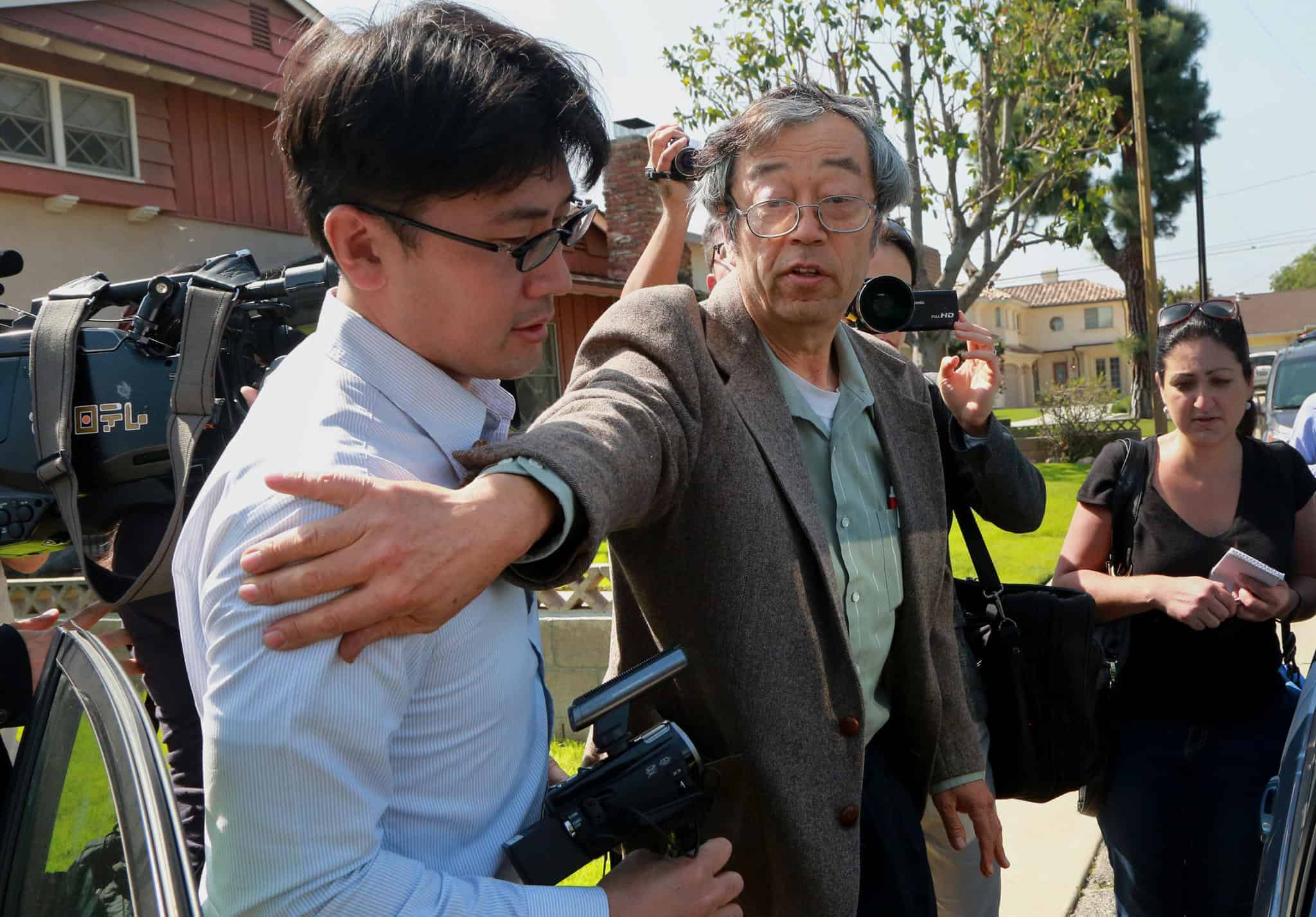
Dorian Nakamoto harassed by the press at the door of his home after Newsweek wrongly suggested he was the person behind the name Satoshi Nakamoto
Later, in an ‘ask-me-anything’ event on Reddit, he said he thought Goodman’s question referred to his work at Citibank.
It seemed that everything was settled when Nakamoto’s profile on the P2P Foundation was reactivated and posted: ‘I am not Dorian Nakamoto’. Some claim that the account was hacked, and someone even claims to be the author of the hack, but we are not aware of any proof of this.
While Dorian gives two versions of how he interpreted Goodman’s question, we cannot help but wonder whether he is trying to cover for Hal Finney. We should point out that Finney and Dorian lived just a few kilometers apart, and they may have crossed paths more than once at a talk, conference or symposium. Dorian became a libertarian and Finney was a renowned Cypherpunk. This opens up the possibility of a very interesting common thread between the two.
The Wright Satellite
At this point we should say that Hal Finney, Nick Szabo and Dorian Nakamoto were residents of the United States at the time and could have met at some point. Wei Dai was and is also American, as far as we know, and the only one who is not American is Adam Back, although Dai and Back have never been seriously considered to be Satoshi Nakamoto.

Craig S. Wright in his office
We call Craig Steven Wright a satellite because he is one of the candidates most strongly rumored to be Satoshi Nakamoto, ever since Wired and Gizmodo pointed to him on December 8, 2015. Added to this, he does not live and has not lived in the United States (as far as is known) permanently or for a long period of time.
Wright is an Australian computer scientist and businessman who was first linked to Satoshi Nakamoto on December 8, 2015 in Wired magazine, which stated that ‘he either invented bitcoin, or is a brilliant hoaxer who very badly wants us to believe he did’
After that publication, neither Wright nor his then-wife posted anything about it on their Twitter accounts. That same day the outlet Gizmodo published a story in which a hacker had allegedly gained access to Wright’s email accounts, saying that the pseudonym Satoshi Nakamoto was used by Wright and computer forensics analyst Dave Kleiman, who died in 2013.
Wright was supported and corroborated as Satoshi Nakamoto by Jon Matonis, former director of the Bitcoin Foundation, cryptography expert Ian Grigg and Bitcoin software developer Gavin Andresen.
Subsequently, reports have been published suggesting that the evidence is an elaborate setup; Wired magazine itself acknowledged ‘having doubts’ that Wright was actually Nakamoto.
Peter Todd, a Bitcoin developer, explained that the post on Wright’s blog that appeared to contain cryptographic proof did not actually contain it.
Bitcoin Core, the core development group of the Bitcoin software, posted a message on Twitter that read: “There is currently no publicly available cryptographic proof that anyone in particular is Bitcoin’s creator”
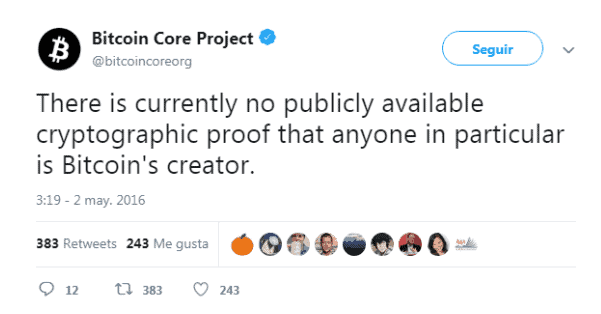
Bitcoin Core, responsible for developing the Bitcoin software, refutes Craig S. Wright
Jeff Garzik, a Bitcoin developer, said that Wright’s proof does not actually prove anything, and security researcher Dan Kaminsky concluded that it was just Wright seeking attention and ‘an international joke’
Charlie Lee, creator of Litecoin (LTC), and Vitalik Buterin, creator of Etehreum (ETH), are among the other figures who denied on their Twitter accounts that Wright was really Nakamoto.
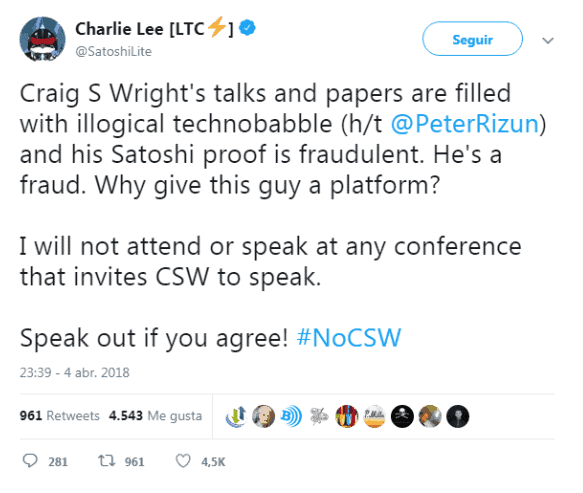
Charlie Lee, creator of Litecoin, mocks Craig S. Wright on Twitter for claiming to be Satoshi Nakamoto
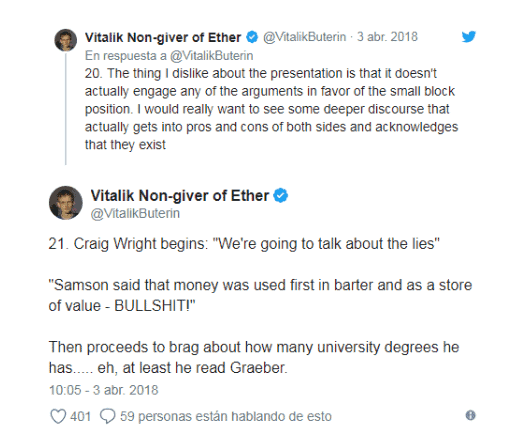
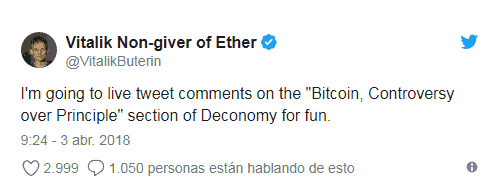
Series of Twitter messages by Vitalik Buterin, creator of Ethereum, explaining why Craig S. Wright is not Satoshi Nakamoto
Emir Gün Sirer, a professor and contributor to Bitcoin’s development, also attacked Wright, pointing out that he had achieved something unprecedented: getting the developers of Bitcoin, Ethereum and Zcash to agree on ridiculing ‘Craig Wright’s technobabble’
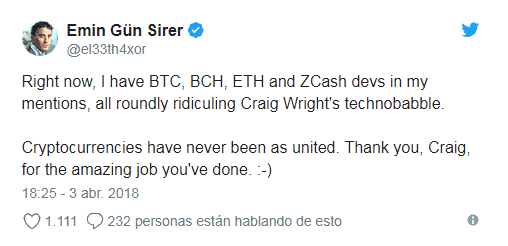
Professor and Bitcoin developer Emin Gün Sirer also sees no evidence that Craig S. Wright could be Satoshi Nakamoto
Other Possible Candidates to Be Satoshi Nakamoto
In addition to these possible candidates, there are other names that have been mentioned at some point by third parties, and which have been denied by those involved. In theory, these would be the least likely. Although in some cases and to some extent they could be, since they have contributed to the development and popularization of Bitcoin as a cryptocurrency. This makes all of them Nakamoto, at least in part.
- The New Yorker: 2011: Journalist Joshua Davis claims that Nakamoto is Finnish economic sociologist Dr. Vili Lehdonvirta and Irish student Michael Clear, who later graduated in cryptography from Trinity College Dublin. Both denied being Nakamoto
- Fast Company: October 2011: Investigative journalist Adam Peneberg, in circumstantial evidence, found data suggesting that Neal Kink, Vladimir Oksman and Charles Bry could be Nakamoto. This claim is based on a joint patent application from 2008 that includes the phrase ‘computationally impractical to reverse’, which appears in Nakamoto’s Whitepaper. The bitcoin.org domain was registered three days after the patent was filed. All three have denied being Nakamoto.
- Wired: November 2011: It is noted that Laszlo Haynecz, a former Bitcoin Core developer, pointed out in one of his emails to Nakamoto that the code was too well designed to be the work of a single person.

Laszlo buying 2 pizzas with Bitcoin again, but this time using the Lightning Network
- Ted Nelson. May 2013: He speculated that it could be Japanese mathematician Shinichi Mochizuki. Later, the journalist published in The Age that Mochizuki denied the possibility, without giving sources or further details
- Vice. 2013: The outlet claims in an article that Gavin Andresen, Jed McCaled and even a US government agency (a nonsensical conspiracy) were candidates to be Nakamoto. It was also suggested that it could be security researcher Dustin D. Trammel, who flatly denied it
- Dorit Ron and Adi Shamir. 2013: These two Israeli mathematicians published a paper claiming there were links between Nakamoto and Ross William Ulbritch. The mathematicians’ suspicion was based on the study of transactions on the Bitcoin network. They later retracted this information
- The Guardian. April 2013: It is speculated that it could be Dan Kaminsky, a security researcher who read Bitcoin’s code and stated that Nakamoto could be a ‘group of people’ or a ‘genius’
- Sahil Gupta. 2017: The former SpaceX employee published on Hackernoon’s Medium that there was a possibility that the CEO of Tesla and SpaceX, Elon Musk, was actually Nakamoto, highlighting Musk’s technical experience with financial software (he is one of the founders of PayPal) and his track record of publishing Whitepapers. On November 28, Musk posted a series of tweets saying this was false
























You must be logged in to post a comment.