
















To quickly understand what blockchain is, imagine you are walking down the street and, suddenly, a flying meerkat of gargantuan proportions lands in a square full of people, eats the ice creams of all the children there, lets out two enormous shrieks and leaves just as it came.
Without a second to lose, the 1,000 people who witnessed it are hooked up to a lie detector and exactly what they saw is recorded.
They all tell the same story with identical details.
Would there be any doubt about the landing of the flying meerkat?
Blockchain: A technology that can change everything
This is the fundamental principle behind the chain of blocks or Blockchain, a technology that has the power to change our relationship with the digital world forever.
Imagine a text file with two columns, where one column contains an identifier (for example “abc”) and the other a number (for example “34”). In other words, “abc” corresponds to “34”. Now imagine that this file could be duplicated on thousands of computers, with the certainty that nobody can tamper with it treacherously, but when something legitimately needs to be changed, within seconds, they all synchronise. Even if one of those thousands of computers disappeared from the network, nothing would happen. This is what Blockchain achieves, and although its magic is much more complex and made up of more pieces such as cryptography, in essence that is what it seeks: a distributed ledger resistant to synchronisation and with no need for trust between the members that make it up. Something people had been trying to solve for decades, and which was achieved in Bitcoin by its creator, the unknown Satoshi Nakamoto.
In the words of Marc Andreessen, creator of Netscape and partner at one of the most important venture capital funds in Silicon Valley:
A blockchain is essentially just a record, a ledger of digital events that is “distributed” or shared among many different parties. It can only be updated by consensus of a majority of the participants in the system and, once entered, information can never be erased. The Bitcoin blockchain contains an accurate and verifiable record of every transaction ever made in its history.
Explaining the parable of the Flying Meerkat
In the previous analogy (sorry about your ice creams, kids), the incredulous individuals who agree when explaining what they saw are, in effect, nodes (later on you will see the role they play in detail) geographically and computationally isolated from one another.
The “lie detector” is shown a “proof of work”, that is, a cryptographic process that proves that a particular computer/chip, and not another, has solved a problem correctly.
Falsifying an entry in the blockchain would be equivalent to getting more than half of the people to agree to lie about the details of the meerkat’s landing in the same way, all at the same time and without being able to coordinate that lie beforehand.
In other words, an “attack” that is hard to carry out.
What is recorded on the blockchain can never disappear. Blockchain is an immutable and permanent record. It is a database that only allows writing. Nothing in it can be modified or deleted, and always under consensus.
Do you realise how significant this is?
Think for a moment about how every interaction carried out online today is backed by a central authority that we trust.
No matter what you do, you are always trusting that someone is telling you the truth, whether it is the bank showing you your account balances, WhatsApp telling you your message has been sent or your antivirus saying everything is fine on your computer.Distributed blockchains have changed everything. Do you know why?
In fact, there is always the risk that an information provider is lying to you or simply making a mistake.
That is why internet security today is chaos in which practically every service can be hacked, manipulated or compromised.
And we entrust them with more and more personal information.
Bitcoin is digital money. But when we think of digital things, we think of files that can be copied and pasted, like your holiday photos, a song or any other file on your computer. But Bitcoin is different because, imagine being able to copy and paste money: it would make no sense. That is why the blockchain, the ledger, exists. Bitcoins do not exist as such, there are no files representing bitcoins, only a ledger that manages, incredibly, to keep the accounts of the entire financial system.
For the first time in history, a book is being written collaboratively by thousands of parties. Imagine any great book, for example the Bible for Christians or any other, written collaboratively, by consensus, without information dictators deciding what to include and what not. Imagine how good such a transparent planet would be.
What does the blockchain have to say about this?
It sounds incredible, but thanks to the concept of distributed consensus an incorruptible record of past and present events in the digital world can be created.
What’s more, it would do so without compromising your privacy.
It can record that the event in question has taken place and that it did so correctly, without spelling out specific details about the type of event or the parties involved.
This explains why bitcoin has been used to carry out illegal transactions since, despite public and free access to the “ledger”, its users’ privacy is guaranteed if so required.
Common misconceptions about the blockchain
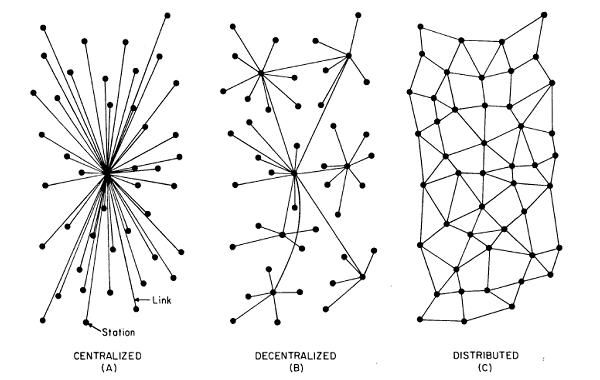
Bitcoin is a decentralised network
Not true.
The blockchain is a P2P network in which all nodes are equal to one another, resulting in a distributed system resistant to cyberattacks, failures or forgeries.
This way, even if a node failed, the nodes it was connected to could be reached through alternative routes.
This would not be possible in a decentralised system.
Blockchain and Blockchain.com are the same thing
This is a misunderstanding common among those new to bitcoin.
As we have seen, the Blockchain or chain of blocks is the powerful technology that brings Bitcoin to life.
Blockchain.com is a service that lets you observe everything happening on the bitcoin network, such as real-time charts reporting on the state of the cryptocurrency, the transactions taking place or detailed information about each operation and mined block.
The potential of the blockchain
If you have made it this far, you will already have realised the enormous potential this technology holds.
So much so that numerous figures in the technology and financial sectors have placed bitcoin and the blockchain on a par with the personal computer industry in 1975 and the Internet in 1993.
One of its most relevant emerging applications has to do with what are known as smart contracts.
They consist of the ability to entrust a distributed network with confirming that a contract of any kind has been fulfilled, without revealing any confidential information about the parties and/or the nature of the transaction.
This could be used, for example, to release a payment to a freelancer you have subcontracted once they finish their work, or for your washing machine to buy detergent by itself once it detects it has run out.
The implications this has for trust and transparency when carrying out transactions of any kind are simply enormous.
4 sectors the blockchain is revolutionising
All this looks very good in theory but, has any company already “got down to work” to unleash the power of the Blockchain?
Of course the financial sector, which is what it was designed for, but that is not the only one. Here are three examples:
1. Distributed cloud storage
Cloud storage services such as Dropbox or Google Drive are centralised, and by using them you are trusting a single provider to “vouch” for the data you store with it.
Storj is a startup beta-testing a service that allows this to be done in a distributed way, using a network based on the Blockchain to increase security and make the service less dependent.
Its users will also be able to rent out the space they do not use to others, just as Airbnb does with accommodation.
2. Patents/Property Registry
One of the first non-financial uses given to the blockchain is the inclusion of encrypted information within transactions.
In this way, an impossible-to-replicate hash can be created that is associated with a unique document stored outside the blockchain.
Imagine the implications this has for registering patents or intellectual property protection.
A company like Google, for example, could prove it created a technology on a specific date without needing to file a formal patent application.
It could link those internal documents to the hash of a transaction made at that moment and thus prove that it was the first to develop it.
Services such as Proof Of Existence make this possible.
3. Electronic voting
As you can imagine, creating ballots and organising all the infrastructure needed to manage voting and the subsequent count is extremely costly.
Electronic voting systems have already been tried, but they have been unable to withstand hacker attacks and have suffered failures when it came to counting with total accuracy.
The Blockchain can solve this, as it would enable a voting system in which voters’ identities are protected. It would be unforgeable (a hacker would need more computing power than the 500 most powerful supercomputers combined, 256 times over) at practically zero cost and with public access.
This system could put an end to the shadow of “vote rigging” that hangs over every election. Especially in countries where corruption is the order of the day.
4. Transparent government
With blockchain technology, any city council or government could display the state of its accounts in real time.
With a network like Bitcoin or Ethereum, a city council or government would only need to indicate which address it manages.
From that moment on, we could all see the state of the accounts, what comes in and what goes out: down to the last cent, in real time and at very low cost.
If at any given moment a payment goes to an address that cannot be justified with an invoice, auditors and the entire population would see it instantly.
Let us also remember that blockchain is a chain, so nothing can be inserted into it after the fact to try to falsify past accounts.
Imagine this in a city council, an institution, or the Spanish government itself (which has been corrupt at every level since the distribution of power following the Franco dictatorship).
Of course, this is not going to come from those who run democracies as if they were dictatorships. So, despite the technological capacity to implement it tomorrow, we still have a long way to go.
What are banks doing about the blockchain?
The financial sector has finally recognised the disruptive potential this technology will have on its industry. In fact, there are new investments in this sector almost daily. In just one month, the references in this section could become outdated.
Indeed, BBVA with Coinbase, Bankinter with Coinffeine and Santander are some examples of Spanish banking giants that have placed their bets through investments to better understand Bitcoin and the role it is playing in the present and, above all, the one it will play in the future.
We also see how one of Estonia’s leading banks is developing a wallet that uses Bitcoin to enable free and instant money transfers.Do you know which banks are betting big on the Blockchain?
We can think even further, putting on the table medical records, voting, property registries, marriage certificates or lawsuits managed by the blockchain.
Eventually, every dataset and digital transaction could leave its “fingerprint”. Creating an easily auditable trail of every digital event that takes place in history without compromising anyone’s privacy.
Conclusion
It seems clear that if the blockchain as a concept survives the enormous hype it is generating, it could introduce a level of democracy and objectivity into the digital world that is so far unheard of and unattainable in the “physical world”.
Its promise implies a future in which nobody has absolute power over the network and nobody can lie about past or present events.
Furthermore, recalling the initial example of a text document with two columns, where “abc” corresponds to “34”, you should note that at no point was it stated what that “34” is. This is because Blockchain is actually agnostic; it serves to keep an account of things. Then, depending on the case, it will be given whatever “surname” or connotation is desired or that each ecosystem deems appropriate. Along these lines, in the Bitcoin ecosystem the blockchain carries bitcoins, which have a price based on a market value set by people. But this ledger could be used for countless cases: company shares, local currencies, home ownership, diamond identifiers, identities… The potential is limited only by imagination. After all, Blockchain is a distributed ledger that allows value to be transferred.Blockchain is a distributed ledger that allows value to be transferred
Today there are hundreds of projects that, inspired by the idea of decentralisation, are researching how to extrapolate this principle to other things. Often even using Bitcoin’s free and open-source codebase, the first ecosystem to put the pieces together functionally around that ideal.
Don’t forget that Bitcoin is constantly evolving, and so is Blockchain technology. It is such a dynamic sector that every week new solutions, integrations and developments appear that keep taking this technology to new levels.
Do you think it will be able to fulfil the mission of leading us to a more transparent and fair world?



















You must be logged in to post a comment.