

















Blockchain (cadena de bloques in Spanish), is a technology that makes it possible to create a distributed ledger on a network of computers without the need for a central server or database. This ledger can only be updated and managed by consensus among all the parties that make up the network.
For this reason, the computing power of all the nodes in the network is used not only to enter information, but also to protect it against unauthorized changes. As a result, blockchain achieves very high levels of security compared with other technologies.
How does blockchain technology work?
For blockchain technology to work, specific software must first be created for it. This software allows computers to create the network that will run the blockchain in a distributed way.
This is exactly the case with the software of Bitcoin and other cryptocurrencies.
This software is open and protected by free software licenses.
This means that they are public, transparent and can be used, reviewed and contributed to by anyone.
Since it has no localized database or server, a blockchain network is described as a distributed network. This means that the information is replicated on every computer in the world connected to the same blockchain. If more than 50% of the computers that make up that blockchain network do not belong to the same person or company, we can say that the network is decentralized. In other words, it has no “center of issuance, control or power”.
In essence, a blockchain network is simply a database that allows new records to be read and written, all without being able to modify anything already in it.
All the records stored in it are linked to one another through highly advanced mathematics, which makes it impossible to include anything that is not consistent with the rest of the records.
How is a blockchain built?
Now, the construction and operation of a blockchain depend on a series of elements that we will examine below:
Blocks
A block is a set of confirmed transactions and additional information that has been included in the blockchain.
Each block in the chain (except the genesis block, which starts the chain) consists of:
- An alphanumeric code that links to the previous block
- The “bundle” of transactions it includes (the number of which is determined by various factors)
- Another alphanumeric code that will link to the next block.
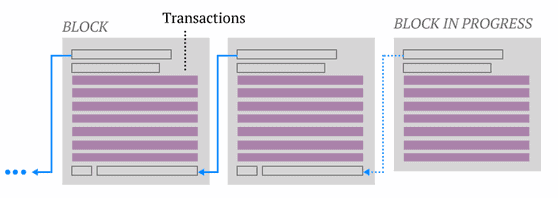
The block in progress tries to work out the third item mentioned above through calculations: a code that must follow certain rules to be valid and can only be found by trying nonstop. But how are these blocks generated? That is the job of the next element we will examine.
Miners
Miners are dedicated computers or specialized equipment that contribute computing power (or mine) to the bitcoin network. This power is used to verify the transactions carried out. Each time someone completes a block, they receive a reward in the form of bitcoins and/or for each transaction made.
Nodes
A node is a computer/chip connected to the bitcoin network using software that stores and distributes a real-time updated copy of the blockchain. Each time a block is confirmed and added to the chain, it is communicated to all nodes and added to the copy each one stores.
One of the most curious features of the bitcoin protocol is that each unit is not a file as such, sent as if it were a movie or song, in the style of a P2P protocol such as BitTorrent. In reality, what occurs is a record of the change of ownership of a given amount of bitcoins on the blockchain. The most common node software on the Bitcoin network is Bitcoin Core.
Of course, all cryptocurrencies follow this three-part structure, each with its own particularities. But this simple way of working maximizes the security provided by blockchain.
Simple visual explanation in Spanish of how blockchain works – Crypto Español

Uses of blockchain technology
Blockchain has quite a few uses. In fact, efforts are already underway to implement it across multiple sectors in a technological race that will forever change essential aspects of our individual and collective lives.
Just as the Internet revolutionized the way information is created, transmitted and consumed, with blockchain technology we are on the threshold of what is known as the Internet of Value or the Internet of Money.
Blockchain technology is essential to the creation of cryptocurrencies. These can be used to transfer value between people all over the world. In addition to digitizing ownership of anything of value (whether tangible or intangible), it allows us, among other things, to create immutable records of property and digital assets that can be transferred between people without requiring a trusted intermediary as has been the case until now (banks, notaries…).
Blockchain and the way it works make this technology one of the most secure we have. All thanks to its distributed structure, the use of strong cryptography and a powerful consensus system that safeguards data integrity.
Conclusion
At this point, we can say that blockchain technology is one of the most powerful tools we have today. Its capabilities and uses are only just being explored. However, the technology has proven its suitability for different uses, radically transforming the way we do things.
Further exploring and developing this technology will take us to a point where we can interconnect the world even more, all without endangering our privacy or the security of our systems and data. Thanks to this, we can say that blockchain technology is taking us to the next step in technological evolution.
























You must be logged in to post a comment.