


















BELOBABA brings us a very interesting article today on the state of bitcoin after the halving, by its Chief Investment Officer, Jesús Sánchez-Bermejo.
Bitcoin After the Halving
Following the bitcoin halving, we have seen how the price, which looked set to rally strongly, is going through a pause and even a somewhat bearish move.
Today I would like to discuss two topics that are important for bitcoin in the long term: relative strength (technical analysis) and the massive buying of bitcoin by strong hands (fundamental analysis). Also, on the subject of the halving, I bring the reader the Bitcoin Block Subsidy Value chart.
Relative Strength
For those less experienced in technical analysis, it is important to understand that, during a major long-term move, prices usually undergo shorter-timeframe corrections to find reliable support before continuing higher. This is almost always the case, and bitcoin is no exception.
As I write these words, bitcoin is trading around 60,000 USD, a very interesting area, since the 60,000 USD zone is important for its technical implications. This area was resistance in 2021 (it failed to break above 70,000 USD in the last bullish move after the 2020 halving), and therefore, according to the technical analysis textbook, any resistance that is broken tends to become support.
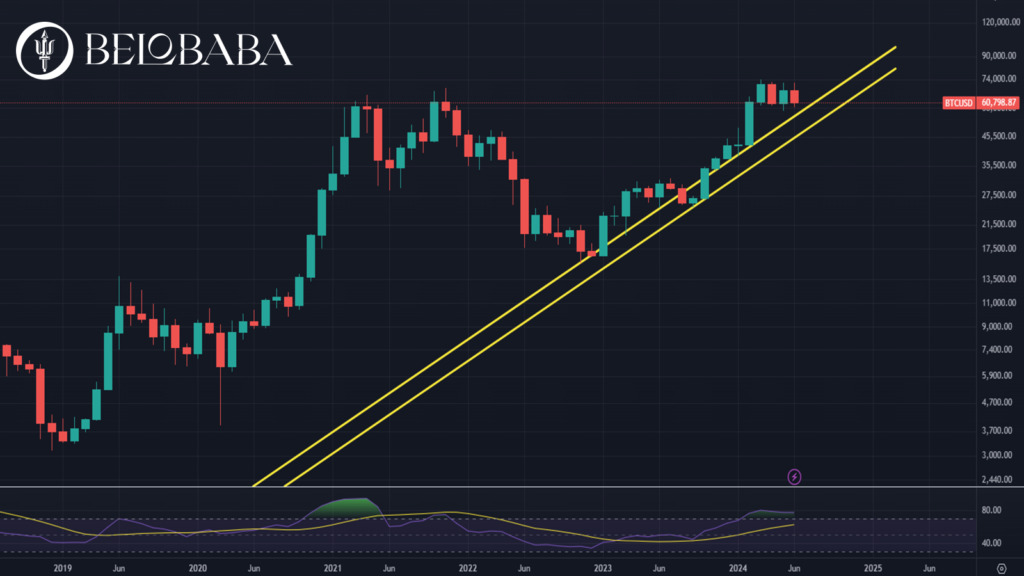
So is this area trying to become support for bitcoin?
Let us remember that in the short term it could even keep falling, with this point representing an opportunity, especially for strong hands in accumulation, which I will explain later. But for now, it is holding (extension to 57,000 USD).
More on Relative Strength: the relative strength of a price is an indicator that, if not used, should at least be taken into account, especially for something as disinflationary as bitcoin.
A situation like the current one on bitcoin’s monthly chart suggests that the price has not stopped rising in the long term.
Similar monthly relative strength levels, looking at past prices, give us very interesting information:
When the price was at 1,115 USD, with a similar relative strength reading on the monthly chart, the price eventually rose to around 20,000 USD (2017). Or more recently, the price was at 28,000 USD with relative strength in the same monthly zone, and that move ended around 65,000 USD (2021).
What does this mean? Relative strength for long-term moves should therefore be observed on larger timeframes, since in short moves the price will always tend to move against the overall trend to work off overbought conditions.
Strong Hands
Meanwhile, as the price cools off from short-term overbought conditions, we see how, more and more each day, big players such as Metaplanet, a Japanese company, are joining others worldwide in acquiring all the bitcoin they can.
So small hands are thinking short term, while big hands are hoarding bitcoin for the long term. On 11 June, there was a bitcoin purchase request from Metaplanet, with 23.321 bitcoin acquired, bringing its holdings at that point to 141.072 bitcoin.
It is not only large North American funds and corporations that are now getting into bitcoin. In my opinion, we are just starting a long-distance race.

More on Metaplanet: a few days ago, the directors of the Japanese company, which is publicly listed, authorised a plan to buy bitcoin worth approximately 6.25 million dollars (1 billion yen). The purchase will be funded with capital raised through the issuance of its second series of ordinary bonds. In other words, bonds (debt) are even being issued to buy even more bitcoin…
This kind of buying by strong hands will keep happening among funds and corporations worldwide; these are not isolated cases, especially considering the few bitcoin left to be mined, another key fact to bear in mind. It is its third purchase in 2 months and it could keep acquiring more. The plan to add BTC to Metaplanet’s treasury has received the backing of partners and investors such as Sora Ventures, UTXO Management and Mark Yusko of Morgan Creek Capital.
The approval of spot bitcoin ETFs has also given the crypto asset a major boost.
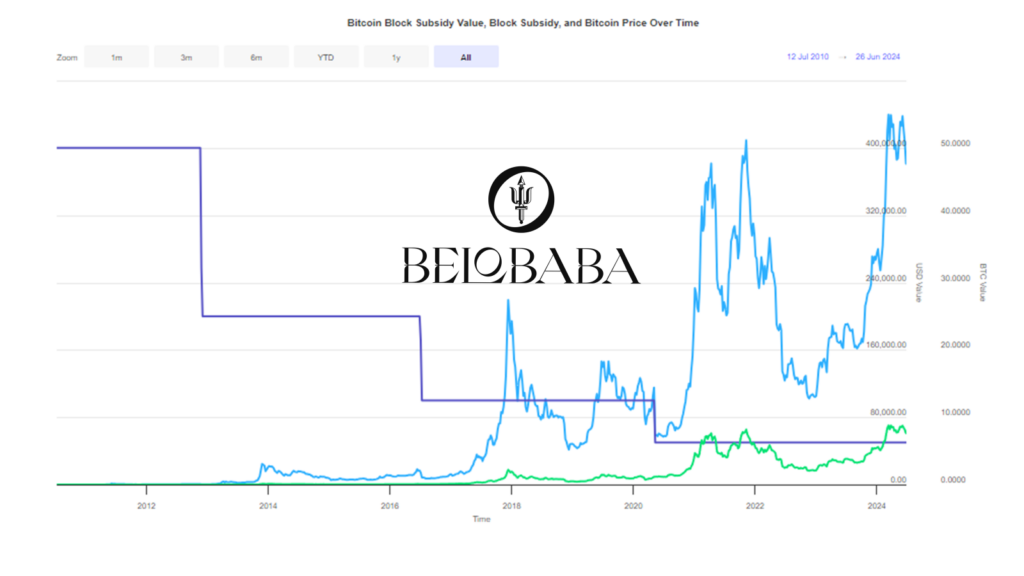
Finally, I add the Bitcoin Block Subsidy Value.
The bitcoin block subsidy, also known as the block reward, is the amount of newly minted bitcoin awarded to the miner who successfully mines a new block. This reward is cut in half roughly every four years (or every 210,000 blocks), a process known as “halving“, the famous halving.
These are the block subsidy values over time:
Genesis Block (first block) to Block 209,999: 50 BTC
Block 210,000 to Block 419,999: 25 BTC
Block 420,000 to Block 629,999: 12.5 BTC
Block 630,000 to Block 839,999: 6.25 BTC
Block 840,000, on 20 April 2024, the moment when the subsidy was reduced to 3.125 BTC.
The block subsidy is part of the miner’s reward, which also includes the transaction fees from the transactions included in the block. This mechanism ensures that new Bitcoins are introduced into the supply in a controlled and predictable way, ultimately capping the total supply at 21 million BTC. Inflation also comes into play here, decreasing over time. Do not forget that bitcoin is disinflationary.
This content is for informational and educational purposes. There is no consumer protection. Your capital is subject to risks. It is not a recommendation to buy or sell any asset or crypto asset. Please do your own research (DYOR) or contact your trusted financial advisor/This content is for informational and educational purposes. There is no consumer protection. Your capital is subject to risks. It is not a recommendation to buy or sell any asset or crypto asset. Do your own research (DYOR) or contact your trusted financial advisor.
Jesús Sánchez-Bermejo