
















The cryptocurrency market moves at breakneck speed. If you’ve been in this space for a while, you’ve surely heard of “perpetuals trading”, “perpetual futures” or, as we’ll call them here, crypto perpetuals. These instruments have become one of the most popular and liquid derivatives products in the ecosystem, allowing traders to speculate on the price of assets such as Bitcoin or Solana without actually owning them.
But what exactly are they, and how can you start trading them safely? Let’s get straight to the point.
What Are Crypto Perpetuals (Really)?
In essence, a perpetual contract is a special type of futures contract that has no expiration date.
If that sounds complicated, let’s simplify it. In traditional markets, a “future” is an agreement to buy or sell an asset (such as gold, oil or BTC) on a specific date in the future at a price agreed today. The problem is that this contract “expires”.
Crypto perpetuals solve this: they let you hold a position (whether betting that the price will go up or down) for as long as you want, as long as you have enough collateral to keep it open.
When you trade perpetuals, you’re not buying Bitcoin; you’re buying a contract that tracks the price of Bitcoin. This gives you two key superpowers: the ability to “go short” (profit if the price falls) and access to leverage.
The Heart of the Perpetual: Leverage and Funding Rate
To understand perpetuals, you only need to master three key concepts: leverage, liquidation and the funding rate.
1. Leverage
Leverage is what draws so many traders to perpetuals. It lets you open a position much larger than the capital you actually own. For example, with 20x leverage, you could control a $1,000 position in SOL-PERP (the Solana perpetual) using just $50 of your own money as collateral (margin).
This means that if the price of Solana rises 5%, your $1,000 position is now worth $1,050. You’ve made $50, which represents a 100% return on your initial $50.
2. The Dark Side: Liquidation
This is where leverage shows its risk. If you used 20x and the price of Solana falls 5%, your $1,000 position is now worth $950. You’ve lost $50, which is all the margin you put up. At this point, the exchange “liquidates” your position, closes it automatically, and you lose your $50. The higher the leverage, the smaller the price move needed to get liquidated.
3. The Magic: The Funding Rate
If there’s no expiration date, what stops the price of the perpetual contract from drifting completely away from the actual (spot) price of Bitcoin? The answer is the funding rate.
This is the most important mechanism of crypto perpetuals. It’s a small payment exchanged directly between traders holding long (bullish) positions and those holding short (bearish) positions.
- If the perpetual trades above the spot price (more people want to go long), the rate is positive. “Longs” (bulls) pay “Shorts” (bears).
- If the perpetual trades below the spot price (more people want to go short), the rate is negative. “Shorts” pay “Longs”.
This rate incentivizes traders to take the opposite side of the trade, helping to anchor the price of the perpetual contract to the asset’s spot price.
Advantages and Disadvantages of Trading Perpetuals
Like any powerful financial tool, crypto perpetuals are a double-edged sword. It’s crucial to understand their benefits and inherent risks before investing.
| Advantages (Pros) | Disadvantages (Cons) |
| High Leverage: Lets you amplify potential gains with small starting capital. | High Liquidation Risk: Leverage also amplifies losses. A small move against you can cost you all your collateral. |
| Flexibility (No Expiration): You can hold a position open indefinitely, without worrying about a forced settlement date. | Funding Rate: If you hold a position for a long time and the funding rate is against you, it can “eat into” your profits. |
| Going Short (Shorting): You can make money in bear markets by speculating on falling prices. | Complexity: They’re not for beginners. They require understanding margin, liquidation and funding rates. |
| Hedging: If you hold spot BTC, you can open a short on perpetuals to protect yourself from short-term price drops. | Extreme Volatility: Cascading liquidations can cause very sharp and sudden price moves (“short/long squeezes”). |
Where to Trade Perpetuals? CEX vs. DEX
You can trade crypto perpetuals on two types of platforms:
- Centralized Exchanges (CEX): These are platforms run by a company, such as Backpack Exchange. They offer high speed, deep liquidity (ease of buying and selling) and often simpler interfaces. They’re the most common starting point for most traders.
- Decentralized Exchanges (Perp DEX): These are platforms built on the blockchain that operate through smart contracts. They offer self-custody (you control your keys), but can sometimes have lower liquidity or be slower.
A Look at Perpetuals Trading on Backpack
For traders seeking a modern, fast and secure experience, next-generation exchanges such as Backpack are gaining ground. Backpack has stood out for its focus on user experience, combining a powerful institutional-grade trading engine with a clean interface.
Trading perpetuals on Backpack gives you access to popular pairs (such as SOL-PERP, BTC-PERP and others) with competitive leverage levels. The advantage of using a CEX like Backpack is the peace of mind of knowing that the platform efficiently handles the complex liquidation infrastructure and funding rates, letting you focus on your trading strategy.
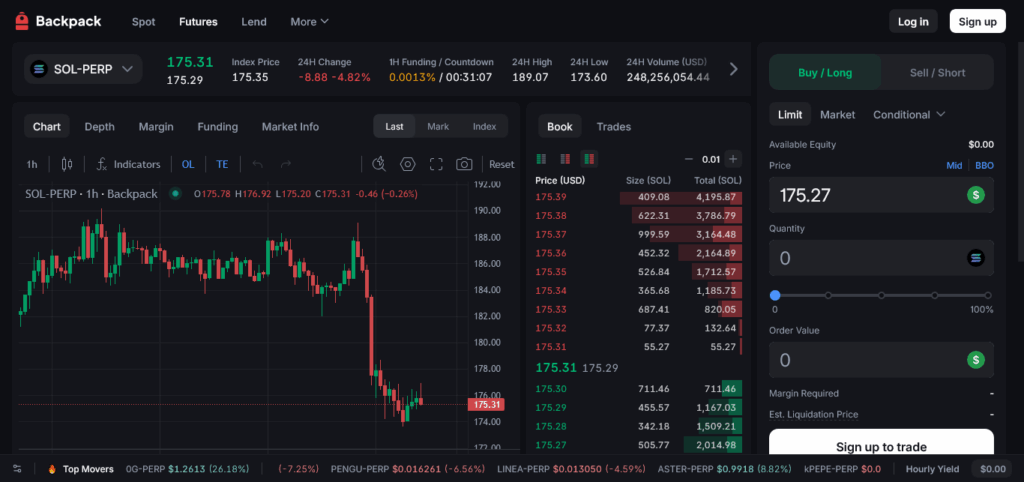
If you’re ready to explore perpetuals trading on a secure and efficient platform, Backpack Exchange offers an excellent on-ramp, combining spot trading with a robust derivatives market.
Conclusion: A Powerful Tool, Not a Game
Crypto perpetuals have revolutionized the way people trade the market. They offer flexibility and profit potential that simple spot trading can’t match. However, their power comes with high risk.
The biggest mistake beginners make is jumping straight into 50x or 100x leverage, treating trading like a casino. The key to success with perpetuals isn’t luck, but risk management.
Before opening your first trade, make sure you understand what a liquidation is, how the funding rate works and, most importantly: never invest more money than you’re willing to lose. With the right education and a reliable platform, perpetuals can be a valuable addition to your trading arsenal.