


















Javier Molina, Markets Analyst at eToro.- Friday’s scare does not change the essentials: the trend remains bullish and, for now, we should stay with it.
But it is also worth telling the other side of the story, the one that serves as a guide for managing risk in a market that is pricing in almost “zero” probability of a recession. This is not a call to run for the exits; it is a reminder to tighten risk management, where we need to understand the moment we are in and that, despite very high multiples, this moment can stretch on even longer.
What should we watch? First, valuations and what the market already takes for granted. The CAPE is trading at about 2 standard deviations above its historical average, and at these levels the SP500 is pricing in earnings (EPS) growth of 15% a year, twice its historical average. It could happen, but it is a high bar.
Second, the danger of high concentration, where fewer than ten tech companies account for a quarter of global market capitalisation and underpin the AI narrative. This creates several “SPOFs” (single points of failure): if demand for AI-enabled services disappoints or if costs erode margins, the demanding rerating is left without support.
Third, the underlying macro. Private employment is deteriorating, new hiring is falling and households’ real disposable income has recently shown negative stretches. Consumption is holding up, but increasingly supported by the wealth effect and a falling savings rate, not by organic income.
Added to this are two levers that can amplify beta when things go wrong. On one hand, there is the effect of passive management (with more than half the market in index funds) and household exposure to equities at record highs. When we are all in the same boat, rebalancing hurts. And watch out for housing: after four consecutive months of falling prices (still very mild, admittedly), let us not forget that housing has historically led the stock market and deserves close monitoring.
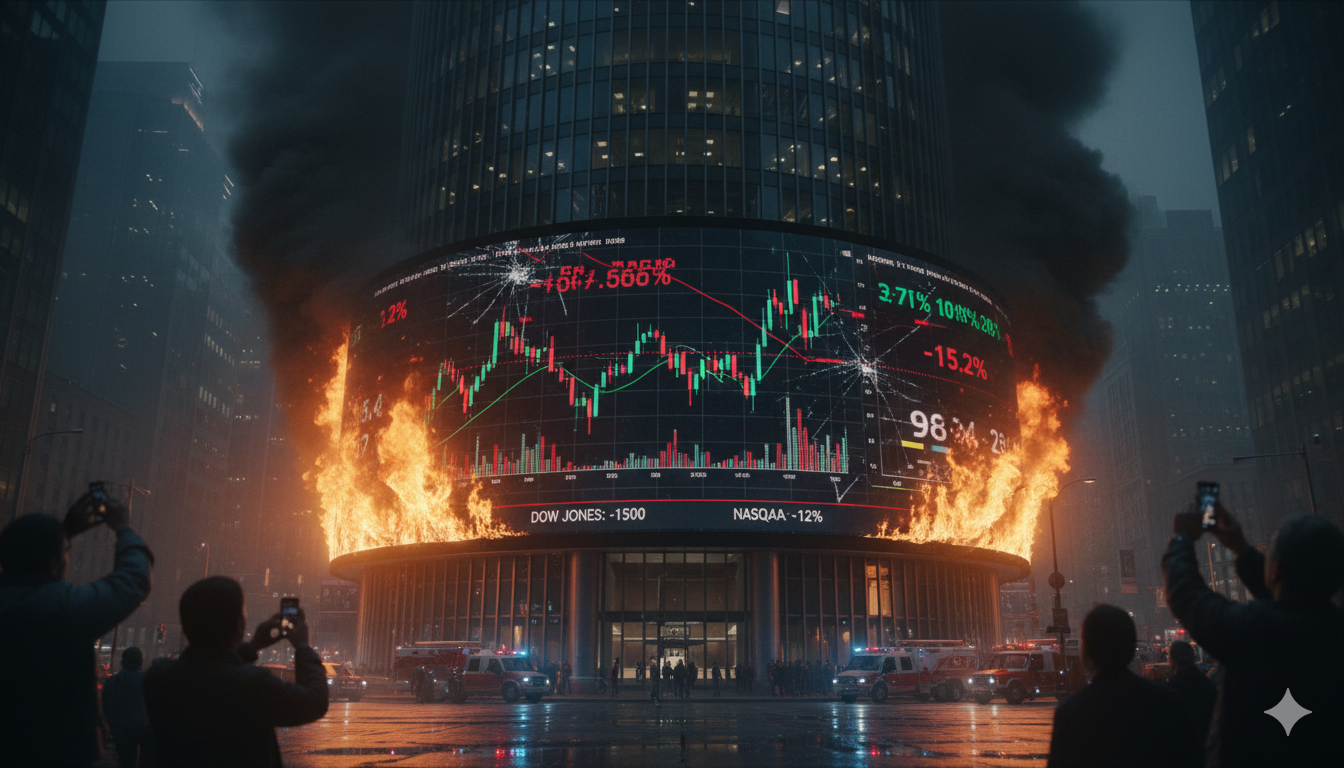
The fourth front is geopolitical. The AI rally depends on supply chains with little redundancy, where a single company manufactures the critical machinery for advanced chips. China controls rare earths and requires re-export licences. It is not a functional embargo; it is bargaining power. But friction, endless licensing or an unfortunate headline is enough to push up timelines and capex. We saw it on Friday with the tariff shock, when the war of words with Beijing was enough to produce the worst stretch since the April scare.
And in the meantime? We remain in “buy the dip” mode, with a tailwind that has not changed: rate cuts on the horizon, liquidity still very high and still growing, and an earnings season that is getting under way and may bring the focus back to margins and guidance.
This week, the big banks take the temperature. Keep an eye on deposit costs, defaults, provisions and the tone in investment banking. Healthcare and consumer will follow. With the “shutdown” delaying data, corporate “guidance” gains weight. If the banks confirm normalisation without cracks, the risk-on narrative can breathe.
How to trade right now? Stay with the trend, manage the asymmetry. In other words, remain long, but with clear and well-defined exit “stops”. Reduce obvious dependencies (extreme weighting in AI mega-caps), scale those “stops” and put hedges in place at the levels where the market accelerates to the downside.
We maintain positions in gold and silver as “tail” insurance in an environment of central bank buying and uncertain policy. They are not an “anti-rally” bet; they are a policy in case the narrative cracks. In credit, prefer quality over late-cycle high yield; current spreads do not adequately compensate for the cycle if the macro cools more than expected.
All things considered, the main bullish trend is still alive, but we must not fall into complacency. Friday was a warning of how sensitive the market is to any spark in a rally with several single points of failure.
The roadmap would be to let the wind push us along, while keeping clear “stops”, putting certain hedges in place, reducing concentration in the usual suspects and keeping a short list of signals that, if they light up at the same time, tell us to reduce risk without drama. Long, but disciplined.
Key technical levels
THESE ARE NOT INVESTMENT RECOMMENDATIONS. Only comments from an informative technical point of view.
1.- S&P
From a technical point of view, first the loss of 6,730 and then a direct attack on 6,550. If this level gives way, the downside target is 6,400 points. Pay attention to Monday’s open, watch volatility and the impact on investor sentiment. This is the time to manage positions well and set the desired risk levels.
Source: investing.com
2.- BITCOIN (BTC)
Crypto Black Friday.
Last Friday, the crypto market experienced one of the worst sessions in its history.
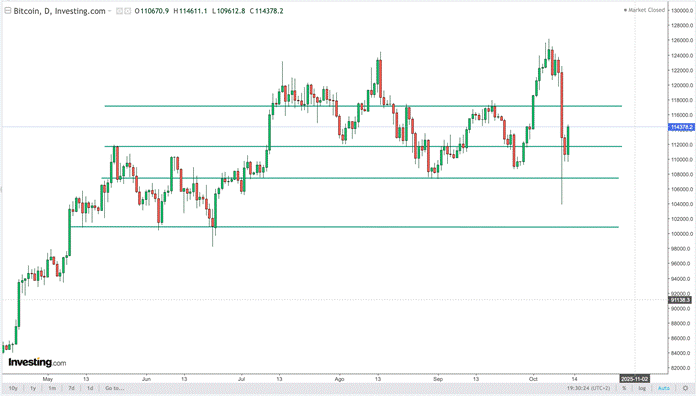
In just one hour, bitcoin lost 15%, dragging down the entire ecosystem. Ethereum lost as much as 20% and many altcoins close to 50%.
The trigger was political (US tariffs on China), but the problem was internal, as we were facing an excessively leveraged market with minimal liquidity.
The crash set off a cascade of automatic liquidations. Perpetual contracts, the flagship product of crypto trading, multiplied the losses, because when long positions are liquidated, the system forces massive sales which in turn liquidate others. In less than two hours, more than 50% of global “open interest” evaporated.
The lesson is clear: much of today’s crypto market volume is not investment, it is financial engineering without real depth. An ecosystem that looks liquid, but where much of the capital is recycled within derivative products. When leverage runs out, there are no buyers, only air.
For investors, the conclusion is simple:
- Avoid products without depth
- Favour direct, custodied and transparent exposure.
- Think of crypto not as a “quick bet”, but as long-term infrastructure within the portfolio.
From a technical point of view, $118K was lost and, despite breaking below $108K, that level was quickly recovered, showing the buying interest that still exists there. That is precisely the last valid control zone. Right now, prices should reclaim and hold $112K in order to attempt to recover the aforementioned $118K.
Source: investing.com