



















Today in our technical analysis section, together with Jesús Sánchez-Bermejo, CIO (Chief Investment Officer) of BELOBABA, we will learn about bitcoin’s cycles, its eras and its possible evolution.
Bitcoin cycles/Bitcoin eras
Bitcoin cycles refer to recurring patterns of growth and decline in the price of bitcoin over time. Although there is no fixed time cycle and market conditions can vary, some analysts and observers have noticed certain patterns that seem to repeat throughout bitcoin’s history. It is important to note that past cycles do not guarantee future results, as the cryptocurrency market is highly volatile and subject to a variety of factors.
Below is a general outline of bitcoin’s historical cycles:
Accumulation Phase:
During this stage, investors may be accumulating bitcoin at relatively low prices after a period of decline.
Bull Market Phase:
This is the phase in which the price of bitcoin experiences a sharp rise. Media attention usually intensifies, attracting new investors.
During bull markets, significant increases in the price of bitcoin can be observed.
Bear Market Phase:
After reaching a peak, the market may enter a bearish phase characterised by falling prices. The correction can be fast and drastic, with a significant drop in price.
During this period, market confidence may decline, and some investors may sell to lock in profits or limit losses.
Consolidation Phase:
After the bearish phase, the market may enter a consolidation phase in which prices remain within a narrower range. A decrease in volatility can be observed, and investors may be assessing the market’s future direction.
On-chain activity may show signs of increased investment and coin accumulation.
Cycle IV
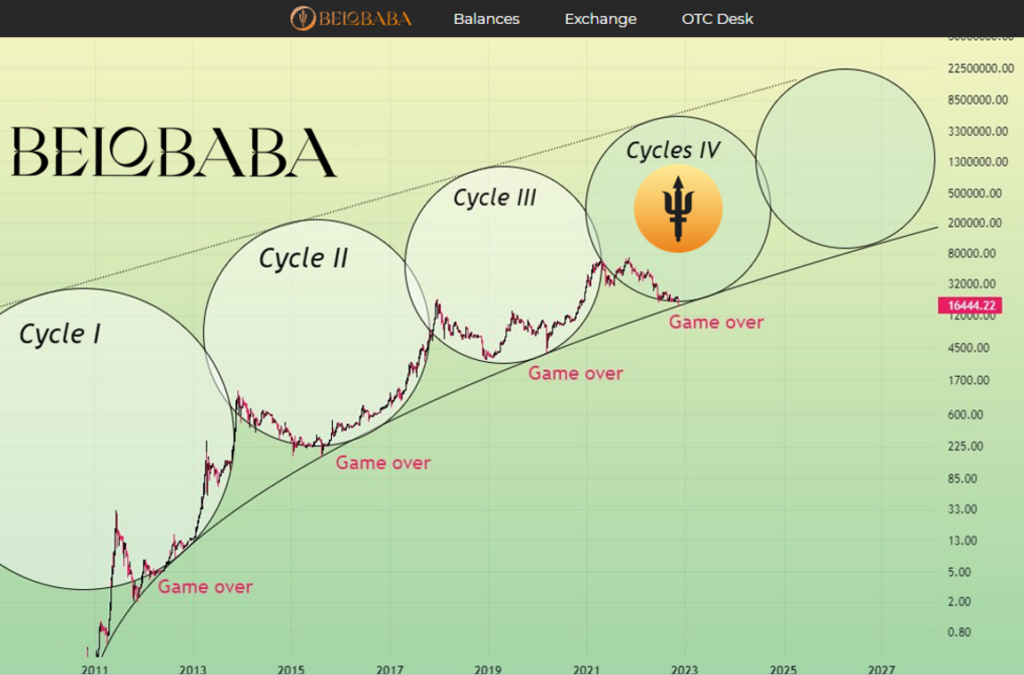
In the following chart we can see bitcoin’s 4 cycles to date (we are in zones exiting the central point of the fourth cycle). The November 2022 lows zone appears important as the final zone of the theoretical fall of the last crypto winter.
Remember that whenever era 4 hits the ceiling/resistance, a new crypto winter would begin that should seek the new LH (low high/long-term continuation higher low), and it would be there, in that zone, where the fifth era would have its low point/accumulation zone, to keep climbing in price, already in the fifth era. But for that, we should still have at least four years to go, understanding that if it respects the entire historical structure it has already built, 2026 should be the year of the next accumulation zone after 2022/2023.
But for that… there is still time, and now, in the fourth era, we are about to reach the new halving, which will mark the next page in bitcoin’s history, while the adoption of blockchain technology is arriving.
At BELOBABA we are convinced that, regardless of the price of bitcoin, blockchain technology as a whole will carry ever greater weight in all sectors of society, even in “big money”, since let us not forget that bitcoin is a fingernail of approximately 0.8/0.9 trillion USD (American trillions are European billions), and Real Estate, with its nearly 400 trillion USD, will be a litmus test for the economic adoption of blockchain technology.
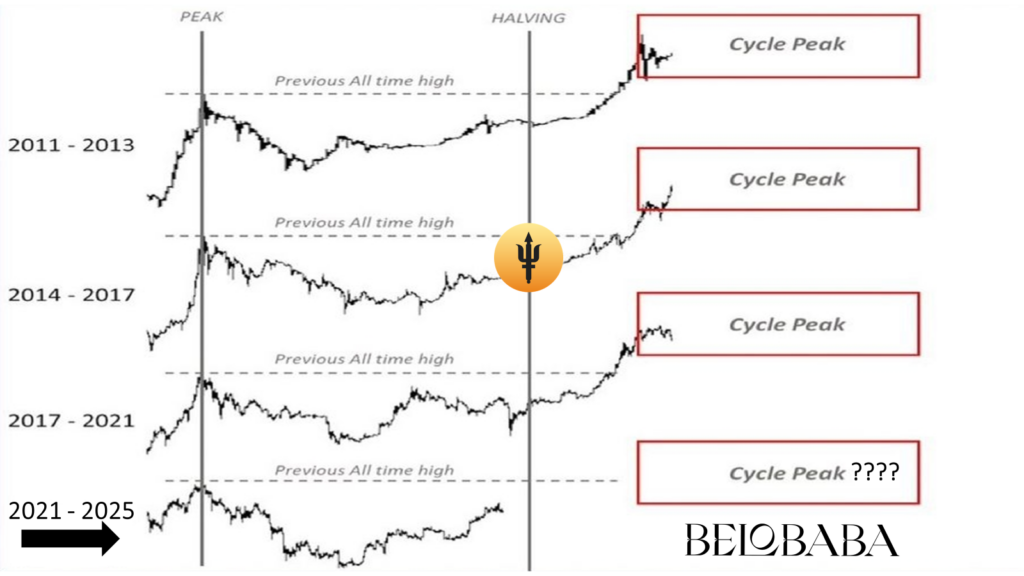
COMPARISON TABLE OF ERAS in search of the Cycle Peak
Comparison of the Peak (tops), the halving (the halving of bitcoin’s mined block reward/new bitcoin issuance) and the Cycle Peak (tops reached after the halving of each era/cycle).
The halving is approaching and, after it, bitcoin’s new move will shape the course of new highs (ATH/All Time High).
We still have little history with bitcoin (born in 2009), but little by little we can study its past to try to shed a bit more light on its theoretical future. We will continue producing articles and reports on our view of the market and the technology, without forgetting that in these public articles, each person is responsible for their own investment decisions.
This content is for informational and educational purposes. There is no consumer protection. Your capital is at risk. This is not a recommendation to buy or sell crypto assets. Do your own research or contact your trusted financial advisor.
Jesús Sánchez-Bermejo