
















Today we once again have BELOBABA commenting on the situation of Solana (SOL), after it overtook Binance Coin (BNB) as the top 4 crypto, through its Chief Investment Officer, Jesús Sánchez-Bermejo.
SOLANA UPDATE
Before analyzing Solana technically, I would like to explain how this blockchain works, how it accrues rewards, and define what a deflationary token is.
How does the Solana network work?
SOL accrues rewards based on the current inflation rate, network performance and the performance of the validator to which it is delegated. To undelegate stake, the user must wait until the end of the epoch. Depending on the timing, this can take anywhere from a few minutes to 3 days.
Holders of unlocked stake accounts are free to delegate or undelegate whenever they wish. Neither Solana Labs nor the Foundation has the power to postpone an unstaking action on stake that does not belong to them. If there were ever an epoch in which the total staked or unstaked exceeded 25% of the current active stake, automated safeguards would split these activations and deactivations across several epochs to prevent network instability. This is what makes the Solana blockchain something very interesting.
Locked stake accounts can be deactivated, split into smaller accounts and redelegated to other validators, but they cannot be withdrawn or transferred to another wallet until the lockup period expires. Another interesting point for Solana.
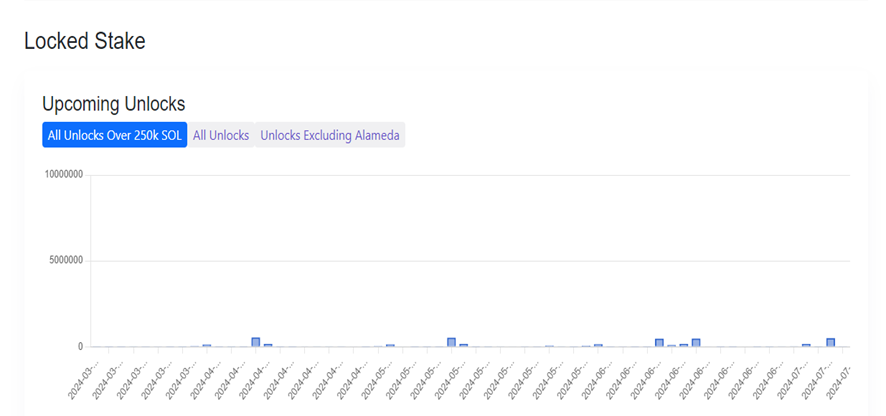
Alameda’s locked stake: Currently, 15,736,660 SOL in locked stake belong to Alameda’s wallets. This represents 34.7% of all locked stake. Since they are subject to Chapter 11 bankruptcy, this stake is unlikely to move immediately once unlocked, until the liquidation process is completed. Similar cases have taken up to ten years to complete.
The following chart shows the upcoming “Unlocks” of SOL, Solana’s token, by date during 2024 through July, relative to current staking (locked SOL deposits).
Fundamental Analysis for SOL
SOL is deflationary
In short, cryptocurrencies whose market supply is constantly decreasing down to a predetermined, fixed amount are known as deflationary.
SOL is a deflationary coin. It started out with initial inflation of 8.00%, currently stands at 5.403% and will end with 1.50% inflation, as shown in the following table.
Deflationary coins should show bullish behavior over time, in the long term. Other deflationary coins include, for example, ethereum (ETH) and the new GKHAN coin from BELOBABA, which will also be deflationary, for those interested.

Technical Analysis for SOL
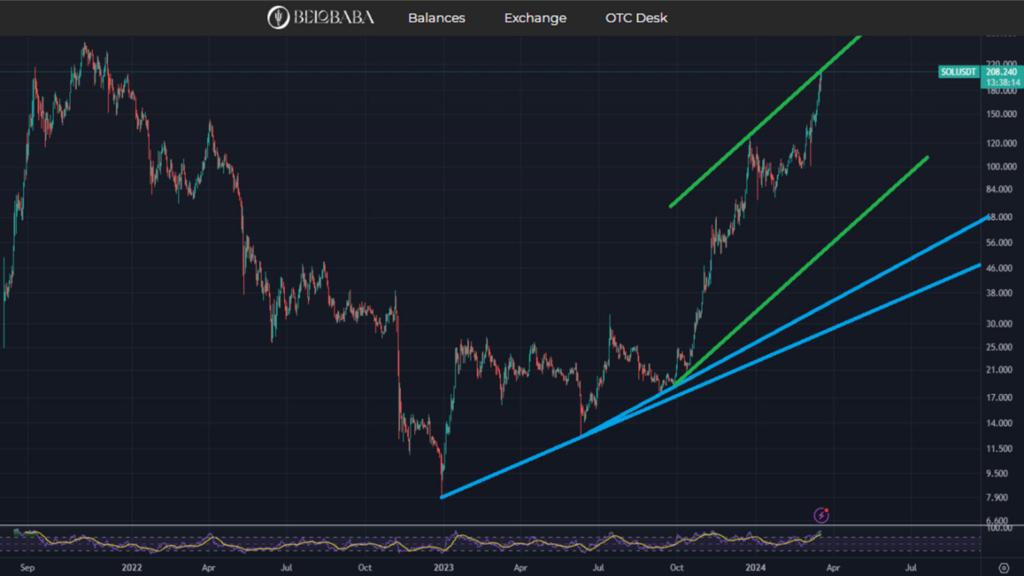
Following long-term bullish behavior, it surpassed 200 USD and managed to rank among the top 4 cryptos.
And now? In the long term it should keep rising, in my opinion, but that doesn’t rule out that, like all charts, it may need higher lows.
Yesterday, let’s say I caught the price at 208.24 USD, theoretically a resistance zone, with a high of around 210 USD.
The following chart shows several bullish trendlines, with the move starting at the end of 2022 and a strong bullish expansion within an ascending channel drawn in green, with point 4 reached (theoretical resistance at 210 USD in the short term).
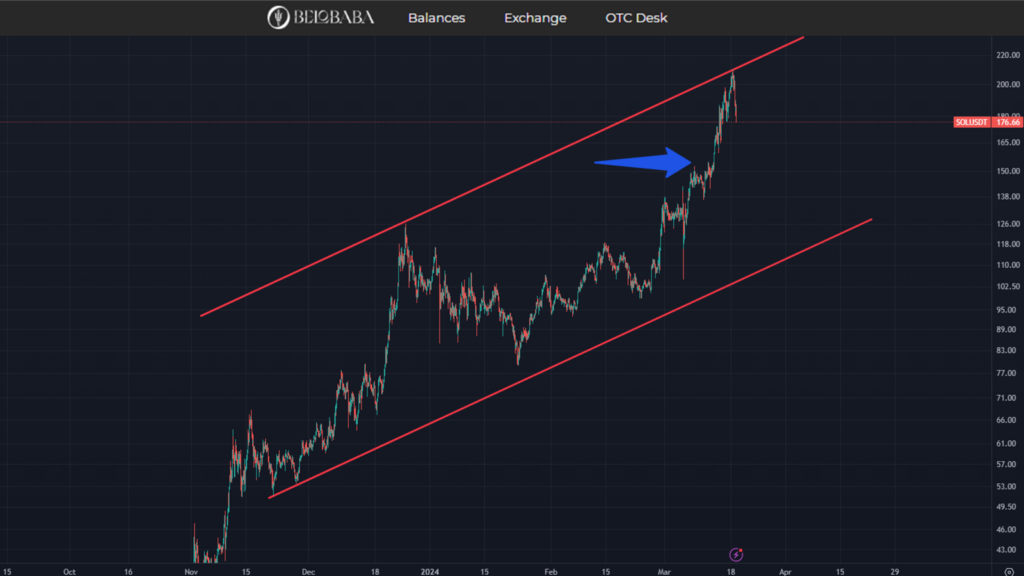
In the following, more zoomed-in chart, as of today, March 19, we observe the following:
It was unable to break through yesterday’s 210 USD zone.
The price has started a rapid decline after becoming the top 4 crypto.
There is an intermediate ascending channel that I have drawn in red.
Its midpoint target (the center of the red channel) corresponds to the last resistance zone before rising to its year-to-date (YTD) high.
The 156/153 USD area could be a possible support level if it needs to fall further in the very short term. If it loses this zone, it could even drop to the lower part of this channel.
The 170 USD area is the nearest initial support. We’ll see how it behaves there.
Going forward it should keep rising, even to challenge its all-time high, but I repeat, prices don’t rise in a straight line; always be cautious in the face of euphoria.
So remember the word deflation for SOL, but also that prices don’t move in a straight line and, even when rising, they need rest and to build support zones on lower timeframes from which to attack new highs again. Good luck with your investment decisions.
This content is for informational and educational purposes. There is no consumer protection. Your capital is at risk. It is not a recommendation to buy or sell any asset or crypto-asset. Do your own research (DYOR) or contact your trusted financial advisor.
Jesús Sánchez Bermejo