














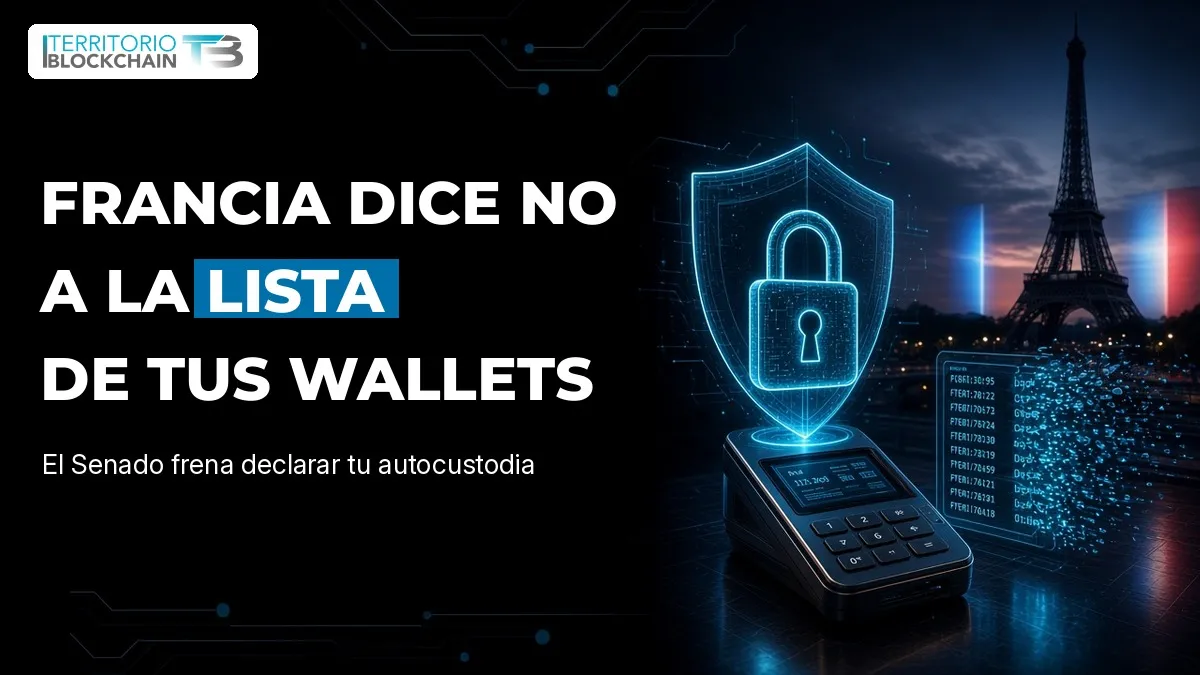

The French Senate has struck down the obligation to declare self-custody wallets worth more than 100,000 euros, along with a tax on swaps from crypto to stablecoins. With more than 70 crypto-linked kidnappings so far this year, the fear that such a list could fall into the wrong hands weighed heavily. Spain has nothing similar, but its tax agency has other windows.
On November 24, the French Senate voted against two amendments that would have changed life for anyone who keeps their cryptocurrencies in their own wallet. The first required declaring wallets held outside any provider when their total value reached 100,000 euros on December 31. The second removed the tax deferral for anyone swapping a crypto for a MiCA-regulated stablecoin, starting January 1, 2027. They were tabled by Communist senator Pascal Savoldelli and the Government opposed both, according to CoinDesk and the text of the amendment. The National Assembly had approved them in October and November, but the revenue section of the 2027 budget later collapsed, so the Senate is closing the door for now.
Why the list was so alarming
Its authors defended it as a way to close a loophole. For them, a wallet that nobody else manages is “the digital equivalent of an undeclared safe”, because the French tax authority cannot know about it, check capital gains or locate it in an inheritance. From their side, it makes sense.
The problem is the timing. PNACO, the French prosecutor’s office against organised crime, counted more than 70 crypto-linked kidnappings or abductions in the first eight months of 2026, compared with 67 in all of 2025, according to franceinfo. And investigators warn OCCRP that gangs no longer target only well-known entrepreneurs, but anyone they believe, rightly or wrongly, holds cryptocurrencies.
On top of that, in February the Finance Ministry acknowledged unlawful access to part of FICOBA, the national register of bank accounts, with names and addresses for 1.2 million accounts. The Gendarmerie cites data leaks as one of the causes behind so many cases. Asking someone to register “I have more than 100,000 euros in a wallet” sounds like handing the map to whoever wants to knock on their door.
Minister David Amiel added another argument. A list of balances does not explain what is done with the cryptocurrencies, so it does not help against money laundering or fraud, and DAC8 already requires platforms to report to tax authorities. On stablecoins, he said they are not legal tender.
What it means for you in Spain
Here there is no obligation to declare your own wallet merely for having it. But that does not make you invisible, and the thread linking both stories is DAC8, the directive we covered in our November 21 article on Brussels’ yellow card.
Under DAC8, your exchange reports your purchases, your sales, your crypto-to-crypto swaps and the transfers you send to a wallet that does not belong to any provider. The tax agency does not see the balance you keep there or what you do afterwards, but it does see that you withdrew funds to your own custody, with their value and units. Part of what the list sought therefore arrives via the European route.
The timeline is as follows. Providers have been collecting data since January 1, 2026, they report to their tax authority in 2027, and tax authorities exchange it before September 30, 2027. Spain still does not have its law, which lapsed with the dissolution of Parliament, and the country votes on November 29. Even so, if your exchange is in another EU country, that tax authority must send your data to the Agencia Tributaria. And if you use a Spanish one, it already receives your balances and transactions through forms 172 and 173.
With stablecoins, the comparison is curious. In France, crypto-to-crypto swaps are not taxed, which is why lawmakers wanted to change it. In Spain, that debate was settled long ago, and in the harshest way, because swapping bitcoin for a stablecoin already counts as a gain or loss on your income tax.
Switzerland opens the door in 2028
On November 25, the Swiss Federal Council approved 57 jurisdictions with which it will automatically exchange crypto-asset information from 2028, according to its State Secretariat for International Finance. All EU countries, the United Kingdom and several G20 members are included. It is the OECD’s CARF standard, the same one underpinning DAC8.
There are conditions. The partner must show interest and meet the confidentiality and data security requirements, and Switzerland will check this beforehand. My reading, mine alone because the statement does not say so, is that Spain would do well to get its law in order so as not to give any excuses. For you, the practical upshot is that a Swiss custodian will not be a locked drawer for the Agencia Tributaria either.
I believe the French Senate got it right on the list. A register of crypto wealth is a real physical risk with so many kidnappings, and the French tax authority suffered its own leak in February. But the substance of the argument does not go away. States want to know and they will get there by other routes, with DAC8 and CARF, which look at the intermediary and not at your home.
If you keep your crypto in self-custody, you do not need to hide, but it is wise to keep your history at hand, know which addresses are yours and not show off your balance on social media.
Information, not investment advice.
Sources consulted on November 26, 2026
- CoinDesk, French Senate blocks new crypto tax and wallet list
- French Senate, amendment I-2447 on wallet declaration
- French Senate, amendment I-2421 on stablecoins
- FinanceFeeds, Senate rejects declaration of 100,000-euro wallets
- franceinfo, more than 70 crypto-linked kidnappings in the first eight months of 2026
- OCCRP, kidnappings and home invasions in France
- Swiss State Secretariat for International Finance, statement of November 25, 2026
- Spanish Ministry of Finance, draft order on forms 042, 172, 175 and 721
- Territorio Blockchain, Brussels’ yellow card to Spain over DAC8
Get the best of the week in your inbox
Every Monday: the most-read stories on Territorio Blockchain, the new podcast episode and news about our events. Free, no spam.
We will send you an email to confirm. You can unsubscribe at any time with the link in every newsletter. Privacy