














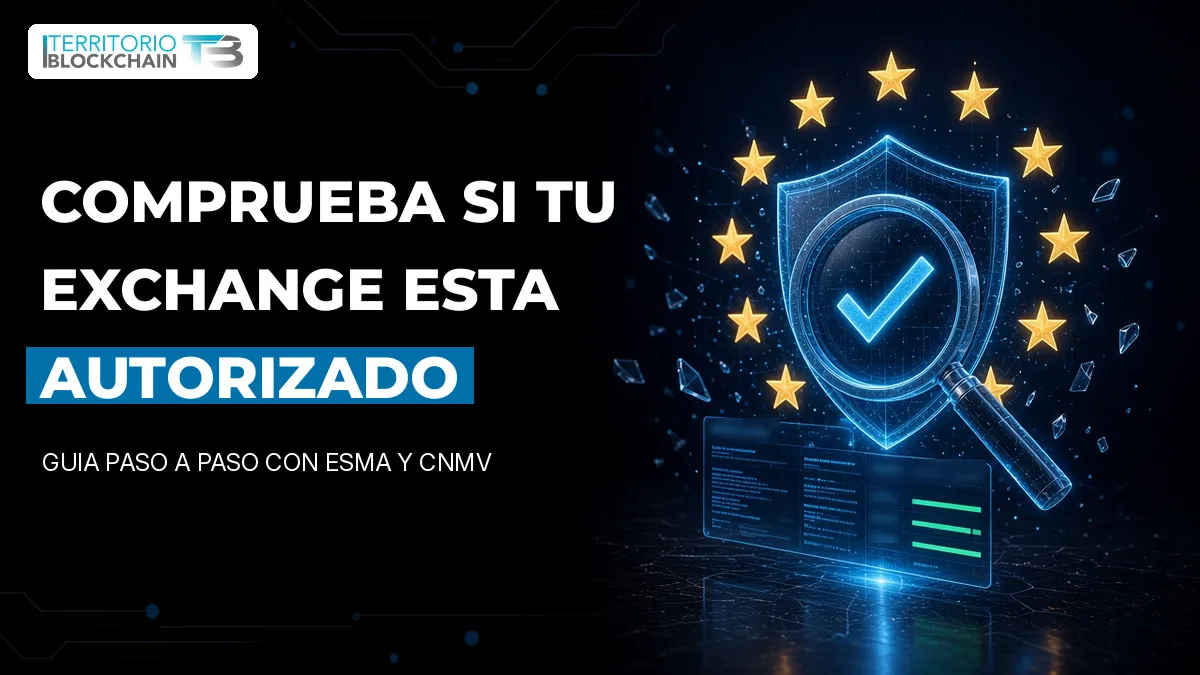

Since 1 July 2026, only crypto providers authorised in the EU can serve customers in Spain. Before trusting a screenshot or an email about account closures, you can check for yourself whether your platform appears in the ESMA register and in the CNMV list. I explain how to do it, what to look for in each row and what will change in 2027.
Since early November, emails and screenshots have been circulating warning of crypto account closures in Spain on 31 December. Some are real. Cinco Días reported on 10 November that Binance has told its users in Spain that it will close their accounts on that date, and a spokesperson for the platform spoke to CoinDesk about «affected accounts». When a notice like that is genuine, copying it and sending it with a different link is easy. That is why it is worth knowing how to check things for yourself.
To me, what an email tells you is one thing and what the public registers say is another. You can do the second check yourself in ten minutes, with two official websites and a spreadsheet.
What changed on 1 July
MiCA has applied in full since 30 December 2024. Each country could grant up to 18 months of leeway to firms that were already operating beforehand. In Spain, according to the CNMV, that transitional period ended on 1 July 2026. Since that date, only providers authorised by the CNMV or by another European authority may provide crypto-asset services in Spain. Other countries set different deadlines, and ESMA publishes the list of those periods.
There is a detail that is often overlooked. MiCA’s protections apply to the authorised legal entity, not to the whole brand. The CNMV itself points out that a group can use the same name for several companies in several countries, and asks you to check in your contract which company is providing the service.
How to check, step by step
1. Find out which company is behind it. Look in the terms and conditions or in the website footer for the full legal name, not just the brand, and write it down.
2. Download the ESMA register. On ESMA’s MiCA page, under «Interim MiCA Register», you will find the «Crypto-asset service providers» file. It is a CSV that ESMA updates every week and that is easier to read when opened in a spreadsheet. If accented characters look odd, import it in UTF-8 format.
3. Find and read the whole row. Locate the legal name in the «ae_lei_name» column and the brand in «ae_commercial_name». It is not enough for it to appear. Check who authorised it («ae_competentAuthority») and in which country («ae_homeMemberState»), the authorisation date, the website («ae_website») and the authorised services («ac_serviceCode»). The «ac_authorisationEndDate» column should be empty, because a date there indicates that the authorisation was withdrawn and ESMA keeps that entity’s record. And «ac_serviceCode_cou» must list the countries where it intends to provide services, including ES.
4. Cross-check with the CNMV. Its website publishes a list of crypto-asset service providers, and the CNMV itself recommends checking both ESMA and its own register. Then go through its warned entities search tool, the list of those it has detected operating without authorisation. ESMA also publishes another file, the non-compliant entities file, listing those providing services without a licence according to national authorities. A company not appearing there does not prove it is authorised. Only the authorised entities file counts.
5. If it does not appear, do not jump to conclusions. Make sure you are searching for the right company and not the brand. If it still does not show up, stop depositing, ask support in writing what the plan is for your funds and consult the CNMV. The register tells you whether a company is listed or not, but it does not explain why.
What the register does not tell you
It is a provisional tool, and ESMA warns about this. It is compiled from the information sent by national authorities, and what they notify or publish in their national register does not always appear instantly. In addition, ESMA clarifies that no authority has reviewed or approved the white papers it contains, and that their content is the responsibility of the crypto-asset issuer. To me it is better than nothing, but it is neither convenient nor immediate, which is why it is always worth cross-checking it with the CNMV.
As for closure notices, being real does not mean they affect everyone. Open the official app or website yourself, typing the address in, and check whether the notice is in your account. Do not log in from a link in a message, and never give your seed phrase or your keys to anyone who contacts you.
What will change in 2027
According to an ESMA spokesperson quoted by Cointelegraph, the interim register will give way around mid-2027 to a web platform with a search tool. It will no longer depend on files sent by email. National authorities will upload and update the data through their own interface, and the system will be able to cross-reference it with databases such as GLEIF, the global register of legal entity identifiers.
White papers will be viewable directly in the register, with version history, and you will be able to download the data in CSV or query it via API. ESMA has not detailed all the features. It also says the timeline reflects only technical development, not the end of the transitional period. A curious nuance: ESMA’s own website still talks about integrating the register into its systems in mid-2026.
To me, the search tool will be a useful step because it will make life easier for users who do not want to open a spreadsheet. Until then, the CSV and the CNMV list are what you have, and they work.
Sources
- ESMA, MiCA page and interim register. https://www.esma.europa.eu/esmas-activities/digital-finance-and-innovation/markets-crypto-assets-regulation-mica
- ESMA, crypto-asset service providers file. https://www.esma.europa.eu/sites/default/files/2024-12/CASPS.csv
- ESMA, non-compliant entities file. https://www.esma.europa.eu/sites/default/files/2024-12/NCASP.csv
- ESMA, description of the register fields. https://www.esma.europa.eu/sites/default/files/2024-12/Description_of_the_fields_in_the_interim_MiCA_register.csv
- CNMV, MiCA and recommendations for investors. https://www.cnmv.es/portal/mica/regulacion-criptoactivos?lang=es
- CNMV, crypto-asset service providers. https://www.cnmv.es/portal/Consultas/Proveedores-Servicios-Criptoactivos.aspx
- CNMV, warned entities search tool. https://www.cnmv.es/Portal/BusquedaAdvertencias.aspx?lang=es
- Cointelegraph, ESMA to overhaul EU MiCA crypto register in 2027. https://cointelegraph.com/news/esma-overhaul-eu-mica-crypto-register-2027
- Cinco Días, account closures on 31 December. https://cincodias.elpais.com/criptoactivos/2026-11-10/binance-fija-para-el-31-de-diciembre-el-cierre-de-las-cuentas-de-sus-usuarios-en-espana.html
- CoinDesk, notice to users in European countries. https://www.coindesk.com/es/business/2026/11/07/binance-users-in-some-european-countries-told-to-pull-crypto-before-fees-kick-in-with-accounts-closing-by-year-end
Information, not investment advice.
Get the best of the week in your inbox
Every Monday: the most-read stories on Territorio Blockchain, the new podcast episode and news about our events. Free, no spam.
We will send you an email to confirm. You can unsubscribe at any time with the link in every newsletter. Privacy