














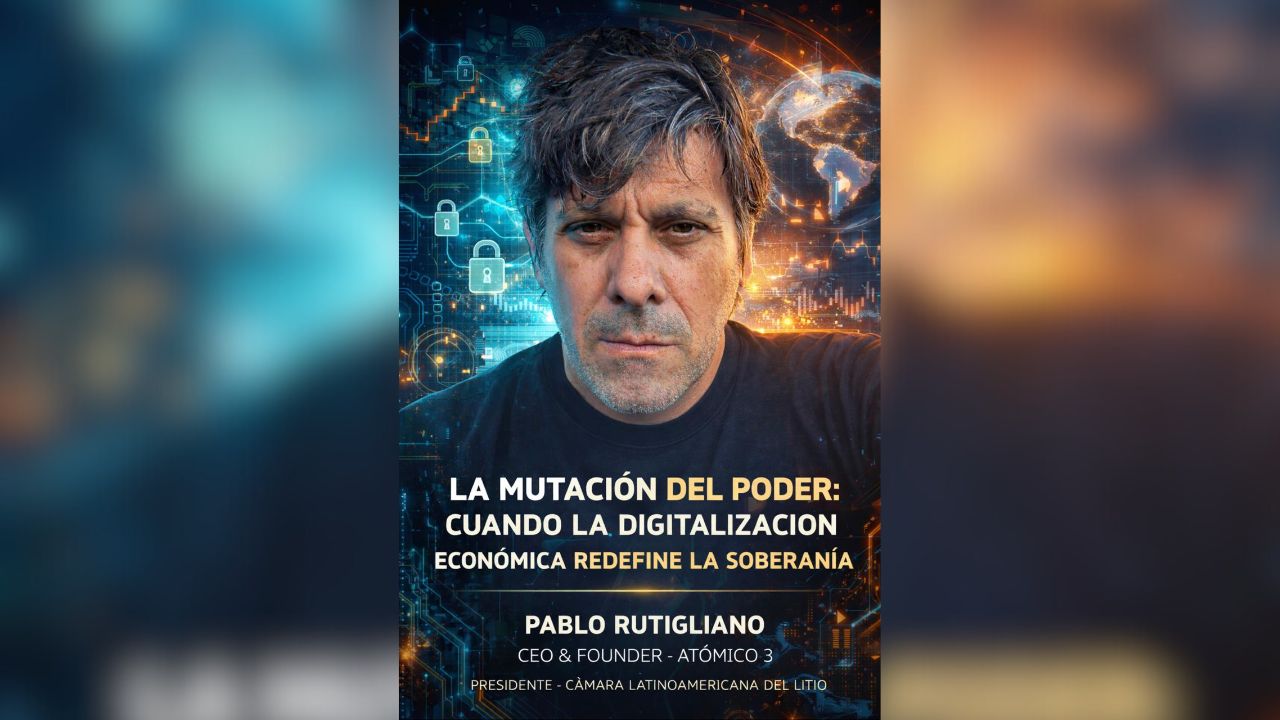

By: Pablo Rutigliano
CEO & Founder – Atómico 3
President – Cámara Latinoamericana del Litio
For centuries, power was explained through territory. Geography, natural resources, borders and physical sovereignty defined who dominated and who depended. However, we are entering a historical stage in which that logic is beginning to mutate. Power is no longer explained solely by the territory one owns, but by the ability to transform that territory into traceable economic value. The mutation of power is called economic digitalization.
The traditional economic architecture, based on opaque, fragmented and often untraceable structures, faces a structural limit. Today’s world demands something that previously did not exist as a central condition of power: traceability. Without traceability there is no trust. Without trust there is no investment. Without investment there is no development. And without development, territory becomes an empty promise.
Tokenization emerges in this scenario not as a technological fad, but as the critical infrastructure of the new economy. Tokenizing is not superficial digitalization; it is converting an asset, a resource, a value chain or a productive structure into a unit of verifiable, auditable and traceable information. It is shifting power from opacity to structural transparency.
In this new model, power no longer resides solely with whoever owns the territory, but with whoever controls the tokenization architecture. Whoever defines how value is represented, how it is recorded, how it is verified and how it is integrated into global markets. Tokenization becomes the new center of gravity of economic power.
The history of humanity can be read as a sequence of mutations of power. In prehistory, power was fire. Whoever controlled fire controlled survival. Fire made it possible to hunt, to eat, to organize tribes, to establish hierarchies. Fire was humanity’s first strategic asset.
Then came land, metals, trade routes, money, industry, energy, information. Each stage redefined power. Each technological revolution shifted the center of gravity of dominance. Today we face a mutation comparable to those: the shift from territorial power to digital power.
The problem is not the natural resource. Argentina, Latin America and much of the world possess extraordinary strategic resources: lithium, copper, gold, gas, water, biodiversity, productive land. The problem is that these resources are not integrated into an architecture of traceable value. They are not tokenized. They are not structured within a model that allows the resource to be transformed into capital.
A territory without capital is a stagnant territory. A resource without traceability is a resource invisible to the global market. An economy without tokenization is an economy condemned to undervaluation.
Sovereignty in the 21st century is no longer measured solely by territorial extent or by the flag flying over a resource. It is measured by the ability to structure that resource economically within a global digital system. Without that ability, sovereignty is formal, but not effective.
Tokenization introduces a disruptive idea: value is not defined by territory, but by the ability to represent that territory in a digital language understandable to global markets. In that language, the token becomes the fundamental unit of value.
But not just any token. Not the speculative token, not the traditional financial token, but the non-tradable token, the token as a representation of a real, traceable, documented, audited asset. A token that does not promise returns, but explains an economic reality. A token that does not replace the asset, but translates it.
In this sense, tokenization is not a threat to sovereignty, but its evolution. Because a non-tokenized resource is a vulnerable resource. A tokenized resource is a resource integrated into the global value system.
The paradox is clear: we may have the territory, but if we do not have the digital architecture to value it, others will value it for us. We may have the lithium, but if we do not have the traceability infrastructure, others will define its price, its narrative and its destiny. We may have the resource, but without tokenization, we do not have the power.
The digital economy does not replace the real economy. It amplifies it. It structures it. It orders it. It makes it visible. It makes it investable. It makes it scalable.
Traceability is the new fire. Whoever controls traceability controls power. Because traceability defines what exists, what it is worth, what can be financed, what can be insured, what can be traded. Without traceability, the resource is a scattered data point. With traceability, the resource becomes an asset.
Tokenization is the bridge between the physical world and the digital world. It is the infrastructure that allows a natural resource to stop being a potential and become an economic structure.
We are living, perhaps without fully understanding it, the prehistory of natural resources in digital terms. Just as primitive man did not grasp the reach of fire, today’s societies do not fully grasp the reach of tokenization.
The resistance is not technological, it is cultural. Traditional models of power resist losing control of opacity. Because opacity is power in the old model. Transparency is power in the new model.
The mutation of power is not optional. It is inevitable.
Economic digitalization is not just another tool. It is the new architecture of power. In that scenario, the countries that understand the logic of tokenization will not only develop their resources, but will redefine their position in the global system.
Territory will remain important. But it will no longer be enough.
Sovereignty will remain relevant. But it will no longer be absolute.
The resource will remain strategic. But it will no longer be decisive.
What will be decisive is the ability to tokenize, to trace, to structure, to translate the physical world into the digital language of value.
The future of economies, of States and of societies is at stake in that translation.
The mutation of power has already begun. And its name is economic digitalization.