














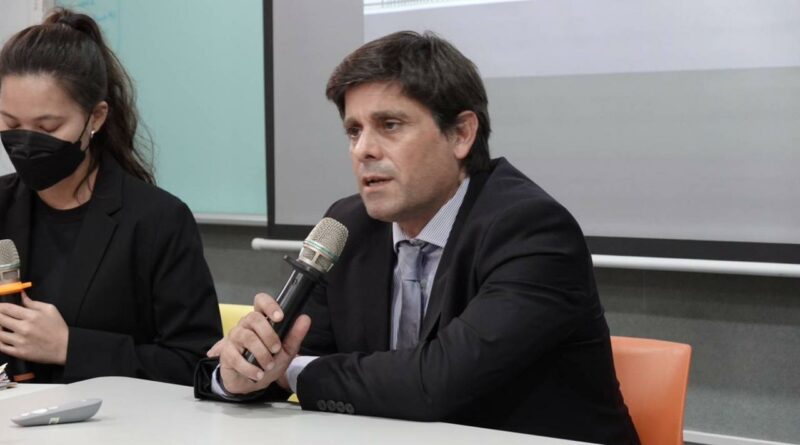

Pablo Rutigliano has become one of the most singular and disruptive figures in the new digital economic order. His name, still emerging for some, is already associated with a conceptual current that is redefining the way societies value, record, exchange and manage their real resources. From lithium tokenization to the creation of a new paradigm of economic transparency based on blockchain, his thinking represents a profound break with the traditional structure of markets and anticipates a systemic change that will expand over the coming decades.
In a world where economic information remains trapped in analog structures, with commodity markets defined by external powers and value chains built without verifiable traceability, Rutigliano’s proposal challenges historical logic at its root. His approach is direct and ambitious: to replace opacity, excessive intermediation and the manipulation of value with an architecture of public, verifiable and immutable data. The idea that the real economy can be reorganized around decentralized recording mechanisms ceases to be a theoretical hypothesis and becomes a concrete, structured and institutionalized plan of action.
What is remarkable about Rutigliano’s thinking is that it does not arise from academic comfort or from the distance of an outside analyst. It arises from direct practice, from the ground where technology tries to make its way through an ecosystem of competing interests, historical resistance and outdated regulatory structures. His work on lithium tokenization is not a conceptual exercise: it is the construction of the world’s first comprehensive model that documents reserves, contracts, production and traceability on blockchain, linking the physical asset with its digital representation in a verifiable, auditable and transparent way.
This methodology, unprecedented in the global mining sector, challenges one of the most opaque areas of international trade: the price formation of natural resources. In most countries that produce strategic minerals, especially in Latin America, value-setting has historically been conditioned by external markets, under-invoicing, discretionary criteria and a lack of access to information. By introducing its own index, structured under international parameters and linked to a platform capable of recording every phase of the production cycle, Rutigliano puts an uncomfortable truth on the table: the structuring of real value must start from the territories where that value is generated.
This approach, far from being purely economic, has geopolitical implications. Lithium is the energy heart of the 21st century; whoever controls its price controls a substantial part of the global technological matrix. In this context, Rutigliano’s thesis is radical: producing peoples must be subjects of value and not objects of the market. Tokenization, understood not as a financial fad but as an institutional tool for transparency, becomes the mechanism that makes it possible to rebuild power relations, redefine economic governance and democratize access to strategic assets.
His book “The Visible Hand of Blockchain Traceability” develops this idea with theoretical depth and conceptual rigor. In it, he argues that the traditional “invisible hand” of markets was never invisible or spontaneous; it was always conditioned by information asymmetries and manipulation mechanisms. Digital traceability, by making every unit of value verifiable, introduces a visible, transparent and objective hand that corrects the systemic failures of analog markets. It is not about destroying the market, but about rebuilding it on scientific, documented and technologically auditable foundations.
This perspective places Rutigliano among the most advanced thinkers in the international debate on tokenization and turns his work into a bridge between classical economic theory and the distributed systems of the 21st century. While global institutions such as BlackRock, Fidelity and Citi explore the tokenization of financial assets, Rutigliano focuses his work on an area not yet conquered: the tokenization of natural resources, especially in regions where the digital economy has not yet been integrated into the production cycle.
The depth of his proposal lies in the fact that it combines four dimensions rarely brought together in a single actor: macroeconomic vision, technological engineering, regulatory knowledge and direct experience in highly sensitive sectors such as mining. This combination gives him a unique position worldwide: he is not a technologist theorizing from software nor an economist theorizing on paper; he is an ecosystem builder seeking to reorganize the real economy through the verifiable digitalization of every unit of value.
The resistance his project has faced—from political, corporate and regulatory sectors—is not a symptom of failure, but evidence that the model questions historical structures of privilege. Economic transparency is not neutral: it redistributes power. That is why those who operate under logics of opacity tend to react strongly to its potential disappearance. Every time Rutigliano insists that producing provinces must record, audit and digitize information, he is affecting multimillion-dollar interests that would benefit from keeping the system as it is.
The academic level of his approach, accompanied by concrete and verifiable technical execution, is the reason his figure is beginning to attract international attention. In technology forums, academic spaces and Web3 communities, he is mentioned as the most advanced reference in real-world asset tokenization in Latin America and one of the few pioneers worldwide in tokenization applied to lithium. Global observers recognize that his project is not an experiment: it is a functional model that could be replicated in copper, gold, land, hydrocarbons and any other resource where the lack of traceability creates structural inequities.
The world’s economic future will be tokenized. This statement, which once sounded like fiction, is today a consensus among global banks, investment funds, international consulting firms and governments that are already studying regulatory frameworks to integrate the digital economy into their production systems. In that future, Pablo Rutigliano’s work will not be seen as a Latin American anomaly or as a solitary initiative, but as a foundational piece in the history of the digitalization of real value.
The economy of the future will demand transparency, verifiability, traceability and universal access to information. It will require systems in which every unit of value—whether a mineral, a property, an energy flow or a service—is documented under an immutable mechanism. And when that new order becomes the global norm, it will be evident that a significant part of that change began much earlier, on a historically sidelined continent, driven by a visionary who understood that technology must not adapt to privilege, but to the truth.