













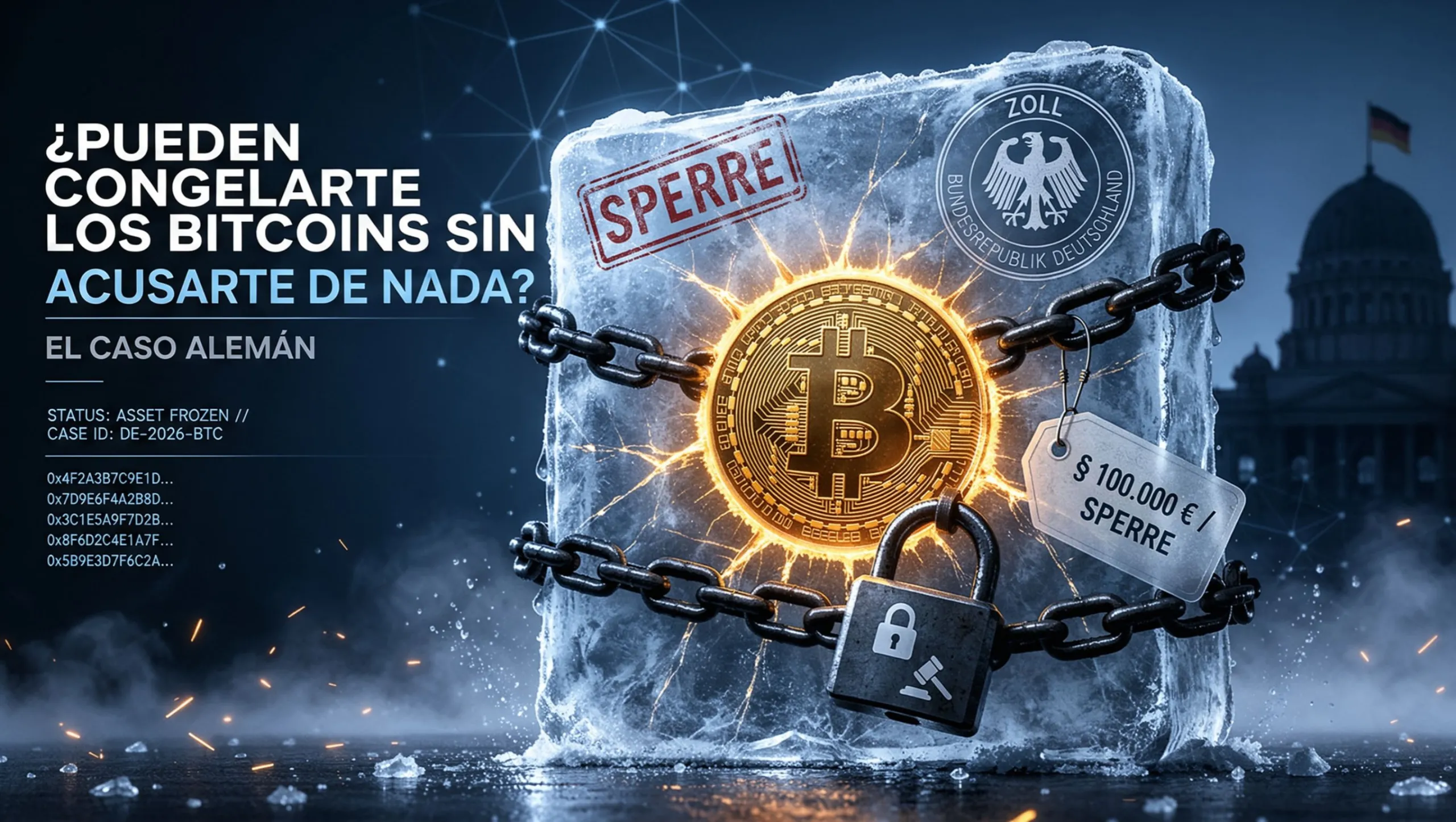

The Bundestag has passed a law that allows German Customs to seize, for 30 days, assets worth more than €100,000 of dubious origin, crypto included, without any criminal investigation being opened. It still needs the Bundesrat’s approval. I’ll explain how it works and what the situation is in Spain.
On Thursday, November 12, the Bundestag passed the Zollfinanzgerechtigkeitsgesetz, the kind of name you only find in German. CDU/CSU, SPD and AfD voted in favour, Die Linke voted against and the Greens abstained, according to Bitcoin.com News. If the Bundesrat, the chamber representing the federal states, gives its approval, it will enter into force on January 1, 2027, as planned by the Federal Ministry of Finance.
The law reorganises German Customs, but what matters to anyone holding crypto is something else. It creates a procedure to investigate and seize assets of dubious origin even when there is no initial suspicion of a crime, as Deutschlandfunk summarises. In other words, without criminal proceedings.
How it works
The procedure only applies to “significant” assets. According to the text, analysed by Perspektive Ausland, that means more than €100,000, or more than €50,000 if the asset is entered in a public register, such as a car or a house. Cryptocurrencies are not entered in any register, so for them the threshold would be €100,000. And the value can be estimated by Customs itself.
The law expressly names crypto-assets as defined by MiCA, European Regulation 2023/1114. That covers bitcoin and the like, but also stablecoins, asset-referenced tokens and utility tokens.
When is the origin in doubt? When, looking at the overall picture, it isn’t credible that you obtained it legally. The law offers clues: your income not matching what you own, unclear beneficial ownership, a record of property crimes, or proof that you lied about where it came from.
These are the deadlines. Customs can seize the assets for up to 30 days to clarify where they came from. If that isn’t enough, a finance court judge can extend that period once, by up to 150 more days. Put another way, your money can stay frozen for almost six months without anyone having accused you of anything.
To keep the assets permanently, Customs must apply to the finance court, which only grants it if it is convinced the origin is illicit. The Finance Committee added that this decision must be taken by a panel rather than a single judge.
Silence won’t save you
On paper, the affected person is not required to provide evidence, and Customs must inform them of this. But the explanatory memorandum, cited by Bitcoin.com News, makes clear what happens in practice: “through mere silence or denial on grounds of ignorance, the affected person will, as a rule, not be able to avoid confiscation” (our translation).
This is where the debate lies. Social Democrat MP Ingo Vogel argued in the chamber that “it is neither automatic confiscation nor a general reversal of the burden of proof.” The German Bar Association thinks the opposite and back in April spoke of a “worrying” reversal of the burden of proof against those affected. The Bundesrat, on the other hand, wanted to go further, with a genuine reversal of the burden and seizures of up to twelve months. The Government rejected it.
The Executive estimates extra revenue of around €308 million a year from 2028.
What it means if you don’t live in Germany
The law is German and applies within the remit of Customs: border and cash controls, customs investigations and the fight against undeclared work. Other authorities, such as the police or the tax office, will be able to alert Customs if they notice something odd. In addition, at border checks, crypto-assets whose storage medium physically crosses the border may be seized. Think of a hardware wallet in your suitcase.
I’ll be honest, here I think of the 2017 investor who bought cheap, never kept the receipts and now has €150,000 in an address. In the eyes of this law, that person must be able to explain where the money came from. It’s like when they ask for the receipt to return a TV: without the paperwork, you’ll have a harder time.
And in Spain?
In Spain I haven’t found an equivalent administrative procedure. What exists goes through criminal proceedings. Since 2015 the Criminal Code has allowed non-conviction-based confiscation, but within criminal proceedings and in specific cases, such as the death, chronic illness or absconding of the defendant. There is also extended confiscation following a conviction, according to the analysis by Asset Protection.
That may change because of Europe. Directive (EU) 2024/1260 requires allowing the confiscation of unexplained wealth when a court is convinced it comes from the activities of a criminal organisation, and the deadline to transpose it expires on November 23, 2026. Spain tried with the Draft Organic Law on Public Integrity, but it lapsed with the dissolution of Parliament on October 5 (Royal Decree 806/2026), as LegalToday explains. So the deadline will pass without a law.
This is how I see it, but nobody holds the absolute truth: going after organised crime’s money makes complete sense, and the German model gives Customs a lot of power before a judge steps in. When the next Government takes up the directive again, it will be worth scrutinising which path it chooses.
Sources
- Bitcoin.com News (DE): https://news.bitcoin.com/de/regulation-and-legal/neues-zollgesetz-bitcoin-unklarer-herkunft-kann-eingezogen-werden/
- Bundesfinanzministerium: https://www.bundesfinanzministerium.de/Content/DE/Gesetzestexte/Gesetze_Gesetzesvorhaben/Abteilungen/Abteilung_III/21_Legislaturperiode/2026-03-03-Zollfinanzgerechtigkeitsgesetz/0-Gesetz.html
- Deutschlandfunk: https://www.deutschlandfunk.de/bundestag-beschliesst-mehr-befugnisse-fuer-zoll-im-kampf-gegen-organisierte-kriminalitaet-100.html
- Perspektive Ausland: https://www.perspektiveausland.com/im-fokus/zollfinanzgerechtigkeitsgesetz-vermoegen-unklarer-herkunft-einziehung
- DATEV: https://www.datev.de/web/de/berufsgruppenuebergreifend/nachrichten/ndsr/steuern/Bundestag-Zoll-kann-staerker-gegen-Finanzkriminalitaet-vorgehen
- Spanish Criminal Code (BOE): https://www.boe.es/buscar/act.php?id=BOE-A-1995-25444
- Directive (EU) 2024/1260 (BOE): https://www.boe.es/buscar/doc.php?id=DOUE-L-2024-80637
- Royal Decree 806/2026 (BOE): https://www.boe.es/buscar/doc.php?id=BOE-A-2026-20742
- LegalToday: https://www.legaltoday.com/opinion/articulos-de-opinion/la-transposicion-de-la-directiva-europea-de-recuperacion-de-activos-el-reto-pendiente-de-la-reutilizacion-social-en-espana-2026-11-04/
- Asset Protection: https://assetprotection.plus/es/actualidad/directiva-ue-decomiso-sin-condena
Get the best of the week in your inbox
Every Monday: the most-read stories on Territorio Blockchain, the new podcast episode and news about our events. Free, no spam.
We will send you an email to confirm. You can unsubscribe at any time with the link in every newsletter. Privacy