





















They are the same model: Fable 5.2 has reinforced safeguards in cybersecurity and biology and is open to everyone; Mythos 5.2 is only available to verified organizations through its cybersecurity and life sciences verification programs, or through Claude Security for enterprises.
It costs $8 per million input tokens and $40 per million output tokens, with an optional fast mode (up to 2.5 times faster) at double the price. It is available on AWS, Google Cloud and Microsoft Azure.
Anthropic says that more than 90% of the changes merged into its main codebase are now written by Claude, and that 1,000 Fable 5.2 agents formalized Fermat’s Last Theorem in Lean in about 30 hours. Fable 5.2 blocks 55% fewer queries than 5.1, and the company deliberately kept its AI R&D capabilities around the level of Opus 5.5. It was evaluated by, among others, the UK AI Security Institute and METR.
Claude Fable 5.2 and Claude Mythos 5.2 show improvements in areas such as coding, reasoning and vision. During pre-release testing, they helped our engineers complete software migrations that would otherwise be unfeasible, designed three working electronic devices from scratch, solved two open problems in black hole physics, made substantial progress on robotics evaluations and formalized the proof of Fermat’s Last Theorem in 30 hours, among many other applications we will discuss below.
Claude Fable and Claude Mythos share the same underlying model. Fable has strong cybersecurity and biological protection measures to prevent misuse, which allows us to make it available to all users. Organizations seeking beneficial applications in cybersecurity or biomedical research can request access to Mythos through our recently expanded Life Sciences and Cyber Verification programs.
Testers have found that Fable 5.2 and Mythos 5.2 communicate more clearly than previous Fable and Mythos models. They generate output up to 30% faster than Claude Fable 5.1 and Claude Mythos 5.1, and are available at a lower price: $8 per million input tokens and $40 per million output tokens.
Fable 5.2 and Mythos 5.2 also include an optional fast mode that speeds up token generation by up to 2.5 times. Fast mode costs $16 per million input tokens and $80 per million output tokens.
Safety and alignment. To ensure that safety and alignment keep pace with the model’s growing capabilities, we carried out extensive pre-release safety testing of the model underlying Fable 5.2 and Mythos 5.2. This included developing novel evaluations that provide deeper insight into specific concerning behaviors, such as sandbox escapes. We believe the high-impact risks stemming from misalignment remain low, and the model performed on par with or better than our recent models on most alignment measures. Fable 5.2’s cyber and biological safeguards are as robust as those of Fable 5.1, but produce fewer unnecessary blocks, and we have deployed our strongest protections to date against distillation attacks.
Below, we describe our safety testing in more detail, and you will find all the information in the Claude Fable 5.2 and Mythos 5.2 system card.
When to use Claude Fable 5.2 and Mythos 5.2. Fable and Mythos are ideal for the most ambitious, open-ended technical work. For most coding and knowledge work tasks, we recommend that users start with Claude Opus 5.5, our main tool for everyday use, and then switch to a different model as needed, depending on the scope and complexity of their work: Fable or Mythos, or Claude Sonnet 5.5 or Claude Haiku 5.5. Fable 5.2 can also work as an Advisor (where Haiku, Sonnet or Opus models consult it to help solve more complex problems) or as an Orchestrator (where it delegates simpler tasks to smaller models).
Evaluating Claude Fable 5.2 and Mythos 5.2
Benchmark performance. The benchmark table below shows that Claude Fable 5.2 and Mythos 5.2 are a step above Opus 5.5 in almost every capability we evaluated:
| Fable 5.2 | Fable 5.1 | Opus 5.5 | GPT-6 Astra | Gemini 4 Carbon | |
|---|---|---|---|---|---|
| Agentic codingFrontierCode 2.0 | 49.1%X-high effort | 32.4%X-high effort | 45.5% | 42.8% | 41.1%Medium effort |
| Agentic codingFrontierSWE v2 | 69.9% | 56.3% | 62.3% | 65.5% | 61.2% |
| Enterprise workflowsAutomationBench | 51.4% | 31.4% | 42.5% | 41.4% | 53.9% |
| Agentic scientific researchTerminal-Bench Science 0.1 | 74.6%75.3% (Mythos 5.2) | 52.6% | 58.7% | 68.1% | 64.8% |
| CybersecurityCyScenarioBench † | 76.3%Mythos 5.2 | 61.7%Mythos 5.1 | 67.6%without safeguards | 61%GPT-6 Cyber | — |
| CybersecurityCVE rediscovery | 89.6%Mythos 5.2 | 78.3%Mythos 5.1 | 81.3%without safeguards | — | — |
| Protein designDe novo binder design (24 hours) | 85.1%Mythos 5.2 | 79.1%Mythos 5.1 | 82.6%without safeguards | — | — |
| Agentic searchWANDR (relaxed scoring) | 82.1% | 68.7% | 72.3% | — | — |
| Computer useOSWorld 2.1 (offline set, partial) | 89.3% | 83.5% | 87.2% | 79.5% | 81.5% |
| RoboticsRoboDojo Sim ‡ | 64.9% | 27.6% | 39.4% | 29.8% | — |
| Knowledge workAA Briefcase v1.1 | 66.1%rubric | 61.5%rubric | 61.2%rubric | 52.0%rubric | 61.8%rubric |
| 1785Elo | 1669Elo | 1800Elo | 1569Elo | 1611Elo | |
| Knowledge workRemote Labor Index (RLI) | 41.3%High effort | 17.9% | 21.3% | 20.8% | — |
| Multidisciplinary reasoningHumanity’s Last Exam (with tools) | 74.2% | 65.6% | 67.7% | 57.2% | — |
| Visual chart recognitionCartography (without tools) | 73.4% | 44.8% | 64.4% | 71.0% | 72.5% |
For details on the evaluation methodology, see the Claude Fable 5.2 and Claude Mythos 5.2 System Card. Scores for Fable 5.2, Fable 5.1 and Opus 5.5 show results with safeguards enabled, unless otherwise noted. All scores show each model’s maximum available effort, unless otherwise noted. † On CyScenarioBench, each lab’s scores are based on single tasks. ‡ RoboDojo Sim shows maximum available effort and was run internally.
Effort and efficiency. At medium effort (the default in the Claude and Claude Code apps), Fable 5.2 can complete complex tasks with fewer tokens than Fable 5.1. In early testing on the FrontierCode 2.0 evaluation, Fable 5.2 at high effort scored similarly to Opus 5.5 at maximum effort, at roughly half the cost per task. At extra-high effort, it also achieved the highest score of all released models tested.
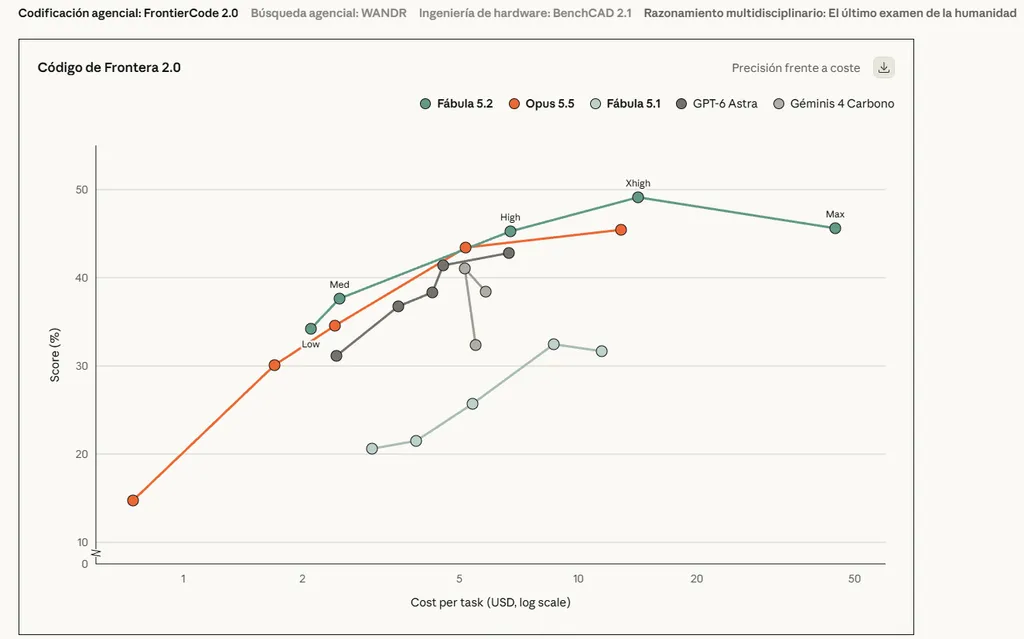
FrontierCode measures whether open-source repository maintainers would merge a model’s code changes. At high effort, Fable 5.2 scores similarly to Opus 5.5’s best score (45.3% vs. 45.5%) at roughly half the cost per task, and beats GPT-6 Astra’s best score (42.8%) at a similar cost. At extra-high effort, Fable 5.2 reaches 49.1%, the highest score of any released model we have tested.
Coding
More than 90% of the changes merged into Anthropic’s codebase are now the work of Claude (with human oversight). We have used Fable 5.2 to fix persistent bugs in minutes, optimize performance across all our services and complete high-value software projects that would otherwise have been too slow or costly. A team of agents using an earlier version of Fable 5.2 migrated a critical production service from Python to Rust; the service is now more efficient, more reliable and starts roughly 26 times faster. We have found that Fable 5.2 shows sound engineering judgment and can produce high-quality results even from ambiguous requests.
As an experiment, an Anthropic engineer tasked Fable 5.2 with designing a prototype operating system. Starting from an empty folder, the model coordinated more than 1,000 subagents, working nonstop for eight days writing, testing and reviewing code. The result was a working operating system that boots on a laptop, with its own kernel to run the system, drivers for the disk, keyboard and network, persistent file storage, windows, a login screen, an installer and built-in Claude functionality (see the video below).
Get the best of the week in your inbox
Every Monday: the most-read stories on Territorio Blockchain, the new podcast episode and news about our events. Free, no spam.
We will send you an email to confirm. You can unsubscribe at any time with the link in every newsletter. Privacy