


















Argentina’s National Securities Commission (CNV) has just shown, once again, its deep legal and technical improvisation with the publication of General Resolution No. 1087/2025, a text that purports to regulate asset tokenization but in reality exposes the incoherence and institutional disorder that govern the agency. What the CNV today calls “regulatory innovation” is nothing more than a poorly made copy of the model developed by Atómico 3, the very same model the CNV itself arbitrarily sanctioned just two months ago, on July 14, 2025. This level of contradiction is the clearest example of the biggest legal travesty in the Argentine financial system in recent years.
The CNV says it now enables the digital representation of real-world assets, but it does so by repeating the traditional structure of financial trusts, shares and corporate bonds. It does not understand —nor does it want to understand— that tokenization is not an extension of the capital market, but a technological revolution that redefines the very concept of value. By copying and pasting old schemes into a new text, the CNV tries to control what it does not comprehend and makes the same mistake again: confusing securities with digital value. Securities fall under its purview; tokenized assets do not. That is why attempting to regulate tokenization from the CNV is legally absurd.
Atómico 3 was unjustly sanctioned in July 2025 for having tokenized mining assets with blockchain traceability under an entirely legal framework. The CNV claimed, without grounds, that the AT3 tokens represented unauthorized securities. In reality, what we did was apply a tokenized certification system to mining assets in three phases: embryonic, certified and productive, with a platform that validates each stage and guarantees full transparency of the process. The token does not represent a share or a corporate bond: it represents a digitized, verified and traceable physical value. Our structure was designed precisely to avoid any legal ambiguity, and even so, the CNV decided to fine us.
The Atómico 3 model was not born by chance. It is the result of years of technical, legal and technological work in mining traceability, applied under national regulations and within international certification standards such as NI 43-101 and JORC. What we developed was a digital certification platform capable of validating geological and production information at each phase of a project: from the embryonic phase —where the first reports and explorations are defined—, through the certified phase —in which technical auditors and regulatory validations come into play—, to the productive phase, which corresponds to the development and actual extraction of the resource. That is the true innovation of Atómico 3: transforming technical and legal data into traceable digital value.
However, instead of recognizing this progress, the CNV decided to sanction the company for doing what they themselves are now trying to regulate. Two months after that sanction, they publish Resolution 1087/25 stating that the “tokenization of real-world assets” is now admissible. In other words, they sanctioned Atómico 3 for getting ahead of the future and then copied its model to present it as an institutional achievement. What the CNV is doing is not legislating: it is justifying its own mistake. There is no legal, technical or ethical coherence.
The text of this resolution falls into the same trap again: talking about innovation while confining the concept within the traditional instruments of the capital market. They continue to regulate financial trusts, shares, CEDEARs and mutual funds, but say nothing about real assets tokenized outside the stock market circuit. Non-financial digital assets —such as those represented by Atómico 3— are not within their jurisdiction. They were not in July and they are not now. Yet the CNV persists in its intention to control what exceeds its powers, showing an alarming lack of judgment.
The resolution also exposes its moral contradiction. For months, the CNV maintained that digital issuances had to be mandatorily listed on authorized markets. That was the excuse to suspend us and publicly spread a false narrative. Today, in its own text, it eliminates that requirement and acknowledges that when an issuance is 100% digital, it no longer needs to be listed. So why did they sanction Atómico 3 if we were applying exactly that technical principle? The answer is simple: because the system cannot tolerate those who get ahead, and Atómico 3 got ahead of everything.
While the world moves toward the real tokenization of commodities, energy, lithium and industrial assets, the CNV remains stuck in the last century. Instead of understanding blockchain as a transparent and traceable ledger, it interprets it as a threat to its control structure. Instead of supporting modernization, it holds it back. And instead of promoting development, it punishes innovation. That mindset explains why Argentina keeps losing global competitiveness: not for lack of talent, but for excess of bureaucracy.
Atómico 3 was sanctioned not for breaking the law, but for complying with it before they knew how to apply it. We created a regulated, transparent, open model that can be validated in real time, with public and verifiable information on the blockchain. No other company in the region had reached that level of traceability. Today, with this resolution, the CNV ends up recognizing —without admitting it— that our path was the right one. But its contradiction does not erase the damage caused: the suspension, the defamation and the persecution were unjust and arbitrary.
What this resolution demonstrates is that Atómico 3 was a pioneer and the CNV a mere late imitator. We talked about real-world assets; they are only now discovering them. We developed certified traceability; they mention it without understanding it. We created a phased certification system —embryonic, certified and productive—; they reduce it to an empty technicality. And while they write resolutions, we write history.
The CNV cannot keep using the power of the State to hide its own technical incompetence. It cannot sanction a project in July and copy it in October. It cannot talk about digital modernization while upholding analog criteria. It cannot keep confusing the legal with the political, or the technical with the financial. This agency needs transparency, professionalism and the humility to acknowledge its mistakes.
Atómico 3 will remain the benchmark for true legal, transparent and traceable tokenization in the region. Our mission is the same: to demonstrate that value is born from information, transparency and verification, not from bureaucratic control. And if the world is talking about real-world assets today, it is because Atómico 3 paved the way. What the CNV calls a resolution, we call a revolution.
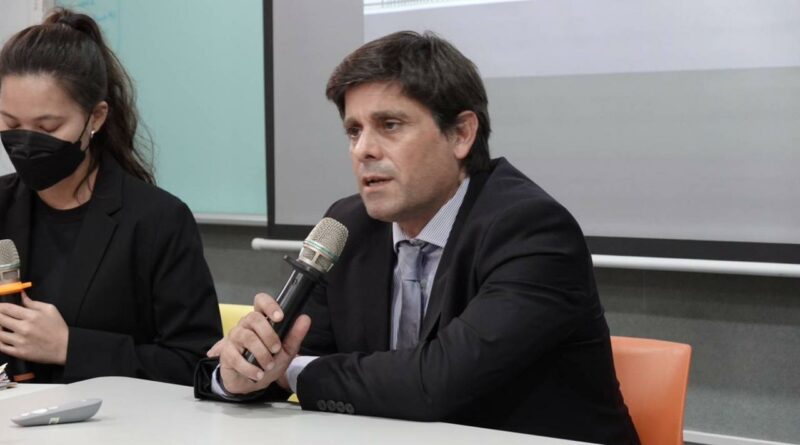
Pablo Rutigliano
CEO & Founder – Atómico 3 S.A.
President – Latin American Lithium Chamber (Calbamérica)