

















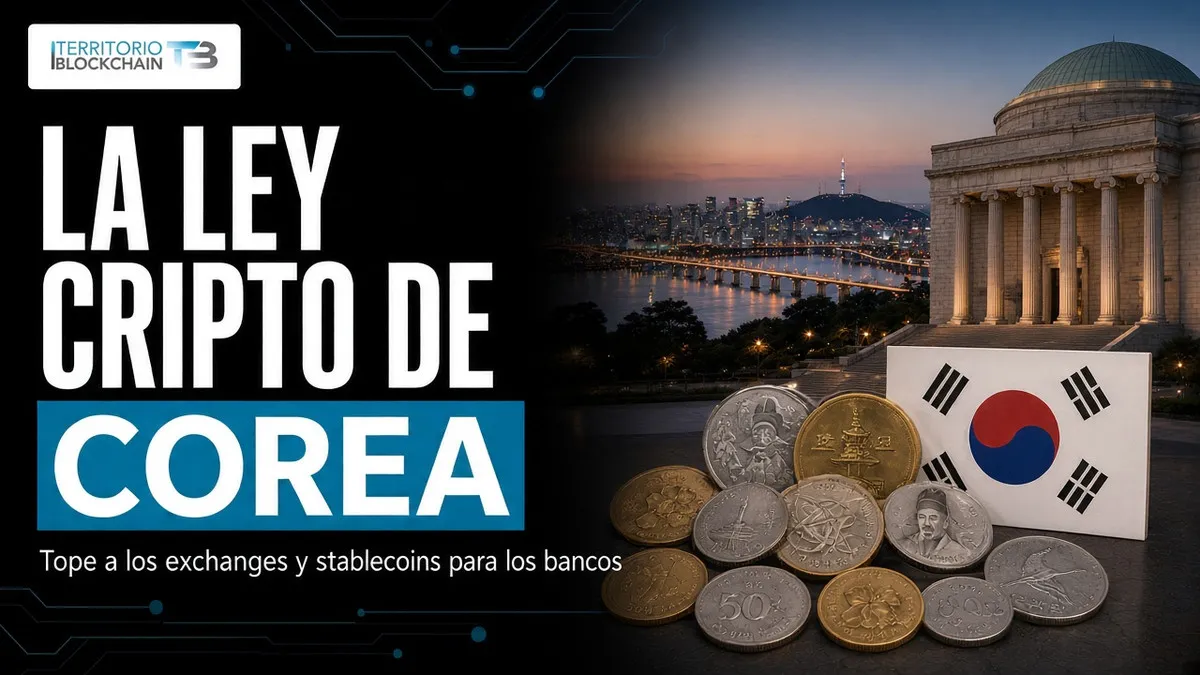

South Korea’s Financial Services Commission on Tuesday unveiled a bill that caps the stakes of major exchange shareholders at 20%, with a maximum of 34% if the regulator approves it, and reserves won-denominated stablecoins for bank-controlled consortia.
It is not law yet; it still has to go through Parliament. The bill, which the Financial Services Commission (FSC) calls the Digital Asset Industry Innovation and User Protection Act, reserves the 34% ceiling solely for financial institutions and other shareholders the regulator deems eligible, and always subject to its approval. If you exceed the limit, the excess shares lose their voting rights.
The FSC’s Director General of Digital Financial Policy, Yoo Young-jun, justified it with a figure. There are more than 10 million open exchange accounts in Korea, and according to him the public accountability and neutrality of those platforms must be strengthened. Existing exchanges will have three years to adapt, starting from when they are designated as digital asset platform operators, and small and medium-sized ones may be granted another three. The current text contains no forced-sale order, but stakes exceeding the limit remain a violation, even if they cannot vote, and the FSC will be able to issue corrective orders, according to MoneyToday.
Who really gets hurt
Mirae Asset Consulting controls 97.15% of Digital X, the exchange known as Korbit until August. It paid 141.4 billion won for that stake in July, according to The Korea Herald. If the 20% cap applies and it does not qualify for the 34% exception, it would have to cut its holding by 77.15 points. Even if it secures the 34%, it would still have to shed 63.15 points.
The other deal up in the air is the one between Naver Financial and Dunamu, the parent company of Upbit. The plan is a share swap under which Naver Financial would take 100% of Dunamu and hand over about 2.54 of its own shares for each Dunamu share. The agreement is still before the Fair Trade Commission. The FSC declined to comment on specific companies, and it is still unclear whether the cap applies only to the exchange’s direct shareholder or extends up to the owners of the parent company.
Won stablecoins, with the bank at the wheel
Won-pegged stablecoins, which the FSC calls “digital payment tokens”, may only be issued, at least initially, by consortia in which banks hold a majority of the capital, more than 50%. A fintech or tech company can be the largest single shareholder in such a consortium, but cannot be in sole control. This was reported by Chosun Biz.
Obtaining authorisation requires minimum capital of 5 billion won, about €3.4 million at Tuesday’s exchange rate. Issuers must also submit an issuance plan, hold reserves of at least 100% in deposits or government bonds in the same currency, keep those assets with a custodian bank or in a trust, and redeem whenever the user requests it. Paying interest to stablecoin holders is prohibited. If issuance reaches one trillion won, the token will be considered “significant” and the Bank of Korea will be able to request data and carry out inspections alongside the supervisor.
What it has copied from MiCA and where it goes further
In Europe, MiCA, Regulation (EU) 2023/1114, does not set an ownership ceiling for exchange owners. If you want to acquire or increase a qualifying holding, you must give notice and the authority assesses you. Article 83 requires notification when that holding reaches or exceeds 20%, 30% or 50%, or when the provider becomes your subsidiary. The supervisor can object on grounds of lack of good repute, financial soundness or money laundering risk. They can stop you, yes. But they do not force you, by law, to stay below a specific percentage.
With stablecoins the difference is clearer. Under MiCA, e-money tokens, those referenced to a single official currency, such as the euro, can only be issued by a credit institution or an electronic money institution, according to Article 48. A fintech can do so if it obtains that licence. There is no need for a group of banks to control more than half of a consortium. Korea is sticking, for now, with the banking model and leaves tech companies as co-pilots, not pilots.
I’ll be honest with you. If you trade from Spain, this law won’t touch your account tomorrow. But it tells you where one of Asia’s most active crypto economies is heading. MiCA focuses on looking at who the owner is and whether they are fit and proper. Korea focuses on preventing any owner from becoming too big, and on giving the bank a seat on the board of the won stablecoin.
That’s how I see it, but nobody holds the absolute truth. An exchange with 10 million accounts is no fly-by-night operation, and demanding neutrality makes sense. The risk is that, by setting the bar so high, the business ends up in the hands of a few banks and two platforms. The Korean Parliament has the final say. Until the law is passed, this is a blueprint, not the house. For your money, nothing changes in Europe for now. If you trade on a Korean exchange or hold tokenised won, it is worth following the process.
Information, not investment advice.
Sources
- South Korea’s Financial Services Commission, press release of 24 November 2026
- The Korea Herald, the 20% cap and the impact on Mirae and Naver
- Chosun Biz, the banking framework for won stablecoins
- Chosun Biz, ownership limits and adaptation period
- MoneyToday, FSC questions and answers
- ESMA, MiCA Article 83, assessment of proposed acquisitions of crypto-asset service providers
- ESMA, MiCA Article 48, requirements for issuers of e-money tokens
- EUR-Lex, Regulation (EU) 2023/1114
- EUR-Lex, MiCA summary in Spanish
- Yahoo Finance, euro-won exchange rate on Tuesday
Get the best of the week in your inbox
Every Monday: the most-read stories on Territorio Blockchain, the new podcast episode and news about our events. Free, no spam.
We will send you an email to confirm. You can unsubscribe at any time with the link in every newsletter. Privacy