





















Javier Molina, Markets analyst at etoro, highlights that Wall Street faces a week marked by inflation and doubts about the profitability of AI investments. Tech concentration and rising volatility are amplifying the declines, while bonds and gold are gaining appeal.
Last week brought a significant correction on Wall Street, with the SP500 losing 2.7%, the Nasdaq 3.4% and the Dow Jones 0.9%. However, the SP500 is still just 5.5% below its all-time highs, so it is worth keeping that perspective before talking about a change of cycle.
The hardest hit were semiconductors, which fell 12% over the week and posted their worst session since March 2020. The selling also reached Asia, with declines of close to 12% in South Korea’s Kospi. The market is beginning to question not so much the growth of artificial intelligence, but rather the volume of investment required and the returns it will ultimately generate.
The US midterm elections add uncertainty, as the Democratic victory opens the door to greater restrictions on the construction of data centers. For Big Tech, scaling back investment could reduce financing needs and protect cash. For chipmakers and infrastructure providers, however, it would mean revising their growth expectations.
In addition, market concentration increases its vulnerability, as seven big tech companies, together with Broadcom, AMD and Micron, account for more than 40% of US market capitalization. When so many expectations depend on a handful of companies, any change in their plans ends up affecting the market as a whole.
On top of this comes a technical factor. Rising volatility is forcing exposure adjustments in systematic strategies. Some models estimate potential selling of around $74 billion associated with the November 5 session. These are not confirmed sales, but they help explain how a correction can accelerate without fundamentals having deteriorated to the same extent.
Meanwhile, US Treasuries posted their fourth consecutive weekly gain, gold rose nearly 5% and Brent fell 13.7% to $97.94. These moves reflect a reassessment of risk and economic expectations.
Next week, inflation and artificial intelligence will once again set the pace.
On Tuesday we will get the US CPI, with a forecast of 3.7%. October employment surprised with 165,000 new jobs, and the probability of a 25 basis point rate hike in December reached 77.1%, according to the CME FedWatch benchmark.
In tech, Taiwan Semiconductor will publish its monthly revenue and we will see results from CoreWeave, Nebius, Cisco and Applied Materials. Also relevant will be Anthropic’s possible presentation to investors ahead of its IPO. Some valuation estimates have reportedly dropped from $2 trillion to $1.1 trillion in just a few weeks, a sign that the market is reassessing how much it is willing to pay for future growth.
What does all this mean for investors?
The correction does not invalidate the artificial intelligence thesis, but it is a reminder that growth, profitability and valuation are not the same thing. Companies will have to show that their enormous investments can translate into sustainable revenue and cash generation.
At the same time, market concentration, position adjustments triggered by volatility and uncertainty over rates may continue to amplify moves.
The question now is to distinguish what part of the declines reflects a real deterioration in earnings expectations and what part stems from positioning and risk adjustments. That distinction will be decisive in interpreting the coming sessions.
Key technical levels
THESE ARE NOT INVESTMENT RECOMMENDATIONS. Only commentary from an informative technical point of view.
1.- S&P
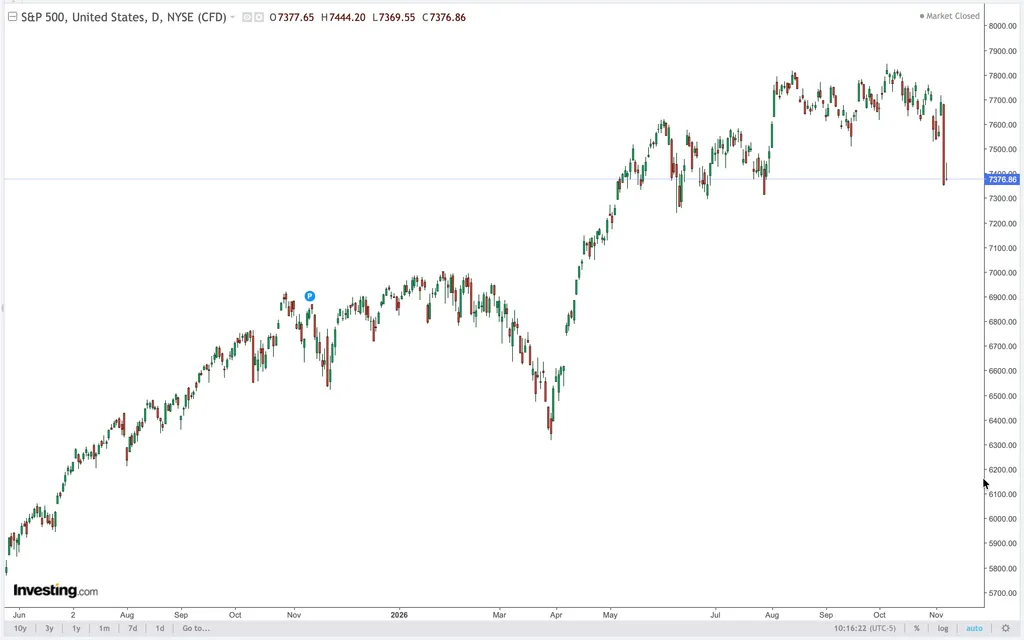
The SP500 closes at 7,736 points, after a sharp drop that has led the index to lose the short-term support located at 7,550–7,600 points. Selling pressure has accelerated and the index is returning to a relevant technical zone.
Key levels to watch this week
- Immediate support: 7,350–7,400 points. Losing it would open the door to a correction toward 7,200–7,250.
- First resistance: 7,550–7,600 points, a former support zone.
- Main resistance: 7,750–7,850 points, where the latest highs are concentrated.
The short-term technical deterioration is evident, although the underlying uptrend has not yet been invalidated. The reaction around 7,350–7,400 points will be important. Reclaiming 7,600 would ease selling pressure; losing 7,350 would increase the risk of a deeper correction.
Source: investing.com
2.- BITCOIN (BTC)
Bitcoin and ethereum facing a market with less liquidity
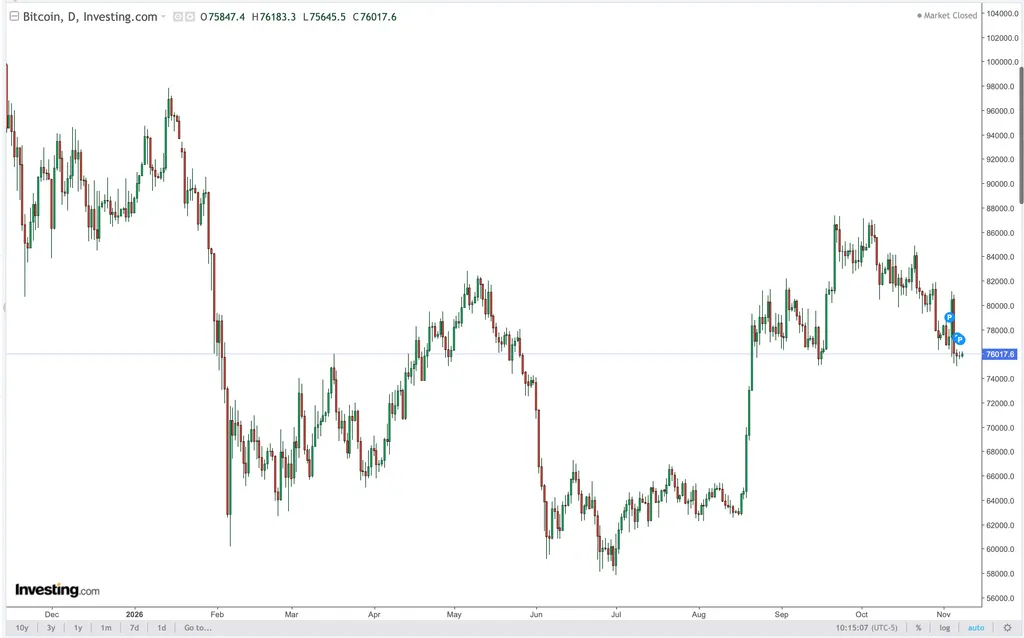
The base case for the coming weeks is that bitcoin continues to consolidate, with more risk of a new drop than of a sustained recovery.
Spot ETFs ended the week with $1.28 billion in net outflows, and stablecoin market capitalization fell 2.2% in seven days. Money is leaving bitcoin ETFs and there is less liquidity available in the crypto market, making it harder for a rebound to hold.
Only 38% of the BTC held by recent buyers is now in profit, and some have already started selling at a loss. If the price returns to their entry level, some of them could take the opportunity to exit and stall the rebound. The sign of improvement would be the rally holding, more BTC from that group returning to profit, and less money leaving the ETFs.
If bitcoin rebounds and ETH lags behind, the recovery will remain concentrated in BTC. If ETH gains ground over several sessions and other more liquid cryptocurrencies follow, we could see a broader market improvement. In the long term, fund tokenization expands the institutional use of ethereum. Its impact will depend on how many assets are managed on the network and the activity they generate.
In the short term, we assign a 50% probability to a consolidation while flows stabilize and recent buyers remain close to breakeven. Likewise, there is a 30% probability of a deeper drop if redemptions persist and realized on-chain losses increase. The remaining 20% corresponds to a firmer recovery, with improving flows, more recent holders in profit and ethereum starting to regain ground against bitcoin.
The upcoming US inflation data could move the dollar and bond yields. To revise this scenario, what happens in the following sessions matters more: if the rebound lasts and flows improve, we will start giving more weight to a recovery. If the price bounces while capital outflows continue, we will remain cautious.
Crypto assets are highly volatile instruments and can experience significant moves over very short periods. The scenarios and levels above are analytical references, not predictions or personalized investment recommendations. Past performance does not guarantee future results
Source: investing.com
Get the best of the week in your inbox
Every Monday: the most-read stories on Territorio Blockchain, the new podcast episode and news about our events. Free, no spam.
We will send you an email to confirm. You can unsubscribe at any time with the link in every newsletter. Privacy