
















On November 19, 2026, the European Commission gave Spain two months to fully apply DAC8, the directive that requires exchanges to tell the tax authority what you do with your cryptocurrencies. That same day it opened a second case against Spain over MiCA. In January, twelve countries had been flagged over DAC8; today only two remain, Spain and Czechia.
A reassuring idea has been making the rounds these days. Since Spain hasn’t passed its law, the tax authority won’t find out about anything. It’s false, and understanding why could save you a headache when you file your 2026 tax return.
What Brussels has decided about DAC8 in Spain
The European Commission’s November infringements package includes two decisions affecting cryptocurrencies in Spain.
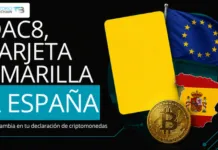
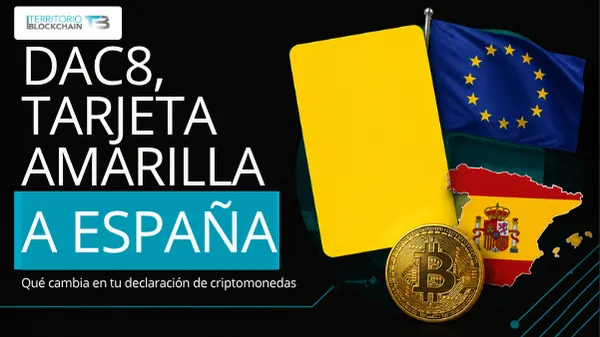
The first is a reasoned opinion (case INFR(2026)0060) for failing to fully transpose DAC8 into Spanish law. An infringement procedure has three stages. First comes a letter of formal notice, which is a request for explanations. Next comes the reasoned opinion, in which Brussels details the breach and gives two months to fix it. The third is a referral to the Court of Justice of the European Union (CJEU). Spain is at the second stage. It’s a yellow card, because there is still no fine or trial, but the next foul gets called in court.
The figure that best captures the situation is in the infringements package of January 30, 2026. Back then, twelve Member States received the letter of formal notice (Belgium, Bulgaria, Czechia, Estonia, Greece, Spain, Cyprus, Luxembourg, Malta, the Netherlands, Poland and Portugal). Ten months later, ten have come off the list.
The second decision is a letter of formal notice over MiCA (case INFR(2026)2153). It’s the first stage and the matter is more technical. I explain it a little further down.
What DAC8 is and what your exchange tells the tax authority
DAC8 is the short name for Directive (EU) 2023/2226, the eighth amendment to the European rules on cooperation between tax authorities. It brings into the European Union an OECD standard called CARF, designed so that countries exchange tax data on crypto-assets.
In practical terms, it works like what already happens with your bank. Your bank reports the interest on your account to the tax authority every year, and you don’t have to do anything for that to happen. With DAC8, your exchange does the same with your cryptocurrencies. It doesn’t create any new tax. You pay the same as before, but now the tax authority knows without you telling it.
According to the directive’s annex, for each EU-resident customer the provider must report all of the following.
- Your name, address, country of tax residence, tax ID number (NIF), and date and place of birth.
- Purchases and sales against euros or another fiat currency, with the total amount, units and number of transactions.
- Crypto-to-crypto swaps, at market value.
- Retail payments over $50,000.
- The transfers you receive and send, including those you send to a wallet that doesn’t belong to any provider.
The scope is broad. It covers bitcoin and other crypto-assets issued in a decentralized way, stablecoins and some NFTs, as set out on the European Commission’s DAC8 page. The timeline is also set. Providers collect data from January 1, 2026, report to their tax authority in 2027, and tax authorities exchange that information before September 30, 2027. Outside Europe, things are moving in the same direction. The Commission counts 76 members of the Global Forum on tax transparency that, as of March 2026, had announced they will implement CARF.
Watch out for this. If your exchange asks for your tax residence or NIF and you don’t respond, the directive requires it to block your transactions after two reminders and 60 days.
Why Spain is late
The directive set a deadline of December 31, 2025. The Government sent its bill to Congress on June 5, 2025, and the text itself acknowledged that it transposed DAC8 “partially”. The bill stalled in the Finance Committee and was never approved.
The end came with Royal Decree 806/2026, which dissolved Parliament and called general elections for November 29. With the dissolution, bills still in progress lapse and must start from scratch. The new Parliament convenes on December 23.
Not all of Spain is in the same position. Navarre passed its own rule, Foral Law 17/2025, effective from January 1, 2026. And since March the Ministry of Finance has had a draft order with the new forms 042, 172, 175 and 721 ready, although the text refers to a “Law XX/XX” that does not yet exist. The forms are sitting in a drawer, waiting for someone to pass the law that gives them meaning.
The MiCA case does not make your exchange illegal
MiCA is a European regulation and applies directly, without waiting for any national law. In Spain it is already in force. The CNMV authorizes and supervises providers and, as it explains on its page on crypto-asset regulation, the transitional period ended on July 1, 2026. Since that date, only platforms authorized by the CNMV or another European supervisor can operate here.
What Brussels objects to are two pieces that depend on the Government. One is an amendment to the banking directive recognizing across the EU that a bank authorized in one country may issue stablecoins or provide crypto services in another, with a deadline that expired on December 30, 2024. The other is notifying the Commission of the national rules through which it applies several MiCA articles, with a deadline that expired on June 30, 2025.
Nothing changes for you overnight. What is worth doing is to check whether your exchange has a MiCA license. And if you want to go over the whole regulation, see our guide MiCA explained.
Do Spanish residents escape the tax authority?
Here is the crux of the matter. Spain being late doesn’t make you invisible.
DAC8 requires each country to send the data of residents of other countries. If your exchange is licensed in France, Germany or Ireland, it reports to that country’s tax authority, and that authority is obliged to forward your data to the Spanish Tax Agency, whether or not Spain has passed its law. And if you use a provider based in Spain, the tax authority already receives your balances and transactions through forms 172 and 173, as stated in the Tax Agency’s Wealth Tax manual.
What really remains up in the air is something else. Without a law there is no specific penalty regime, Spanish providers keep using the old forms, and Spain cannot send other countries the information it owes them. This is our reading of the directive, because the Commission has not detailed which parts Spain is missing.
What changes in your tax return depending on where you hold your crypto
DAC8 doesn’t change how much you pay. What changes is that the tax authority will have data to compare against your return. What you do in 2026 is the first thing that will arrive through this channel, and you’ll notice it when you file your 2026 tax return in spring 2027.
If you use an exchange from another EU country
It will ask for your tax residence and NIF, and in 2027 it will report your purchases, sales, crypto-to-crypto swaps and transfers. What it doesn’t do is calculate your gain or loss. That calculation is still up to you.
If you use a Spanish exchange
Little changes for you, because that provider was already reporting your balances and transactions to the tax authority.
If you use a platform outside the EU
Since July 1, 2026, it cannot serve you in Spain unless it is authorized in the EU. And if it has European customers, DAC8 requires it to register in a Member State and report just like the rest.
If you keep your crypto in your own wallet or use DeFi
The exchange does report the transfer you make to your wallet, with its value and units. What you do afterwards it no longer sees. A purely decentralized exchange doesn’t report either, because the directive only applies to providers. But a swap is still an exchange of one crypto for another and is taxed the same, whether anyone reports it or not.
What you already had to do before DAC8
Selling crypto for euros or swapping one crypto for another generates a gain or loss that goes on your income tax return. It is calculated using the FIFO method (the first coins you bought are the first ones you sell), according to the Tax Agency’s personal income tax (IRPF) manual. Swapping bitcoin for a stablecoin also counts, even if you never touched a euro.
In addition, if on December 31 you hold more than €50,000 in cryptocurrencies held in custody by a foreign provider, you must file form 721 between January 1 and March 31. Those you keep in a wallet whose keys you control are not included. If you want to review the most common mistakes, here are three common mistakes when declaring cryptocurrencies in Spain.
What happens now and how much it could cost
The two-month deadline runs from when Spain receives the reasoned opinion, so it expires around the second half of January 2027. With elections on November 29 and a Parliament convening on December 23, passing a law in that time looks very difficult.
If Spain fails to comply, the Commission can take it to the CJEU and request two types of penalty: a lump sum for the period of non-compliance and a daily fine until it complies. The Commission’s March 2025 communication on financial sanctions set a minimum lump sum of €7,540,000 for Spain. The Commission updates those figures every year and the final amount is decided by the Court.
In the meantime, the sensible thing is to do your own homework.
- Download and save the full history from every exchange, including those you no longer use.
- Write down which wallet addresses are yours.
- Respond when your exchange asks for your tax residence or NIF.
- Check whether you exceed €50,000 with foreign custodians on December 31.
- Consult a tax advisor if you have many transactions, DeFi or staking.
The yellow card was shown to Spain, not to you. But you’re still the one playing the match, because 2026 data will reach the tax authority with or without a Spanish law. Have you already saved the history from all your exchanges?
This content is for informational purposes only and does not constitute tax advice or an investment recommendation. Every case is different and it is advisable to consult an advisor.
Sources consulted on November 21, 2026
- European Commission, infringements package of November 19, 2026 (INF/26/2269)
- European Commission, infringements package of January 30, 2026 (INF/26/115)
- Directive (EU) 2023/2226, DAC8, on EUR-Lex
- European Commission, DAC8 page
- Regulation (EU) 2023/1114, MiCA, on EUR-Lex
- Congress, bill 121/000060 (BOCG A-60-1)
- BOE, Royal Decree 806/2026 dissolving Parliament
- BOE, Navarre Foral Law 17/2025
- Ministry of Finance, draft order for forms 042, 172, 175 and 721
- CNMV, crypto-asset regulation (MiCA)
- Tax Agency, 2025 Wealth Tax manual, virtual currencies
- Tax Agency, 2025 IRPF manual, virtual currencies
- Tax Agency, form 721 FAQ
- Commission communication on financial sanctions (OJEU of March 5, 2025)
Get the best of the week in your inbox
Every Monday: the most-read stories on Territorio Blockchain, the new podcast episode and news about our events. Free, no spam.
We will send you an email to confirm. You can unsubscribe at any time with the link in every newsletter. Privacy