

















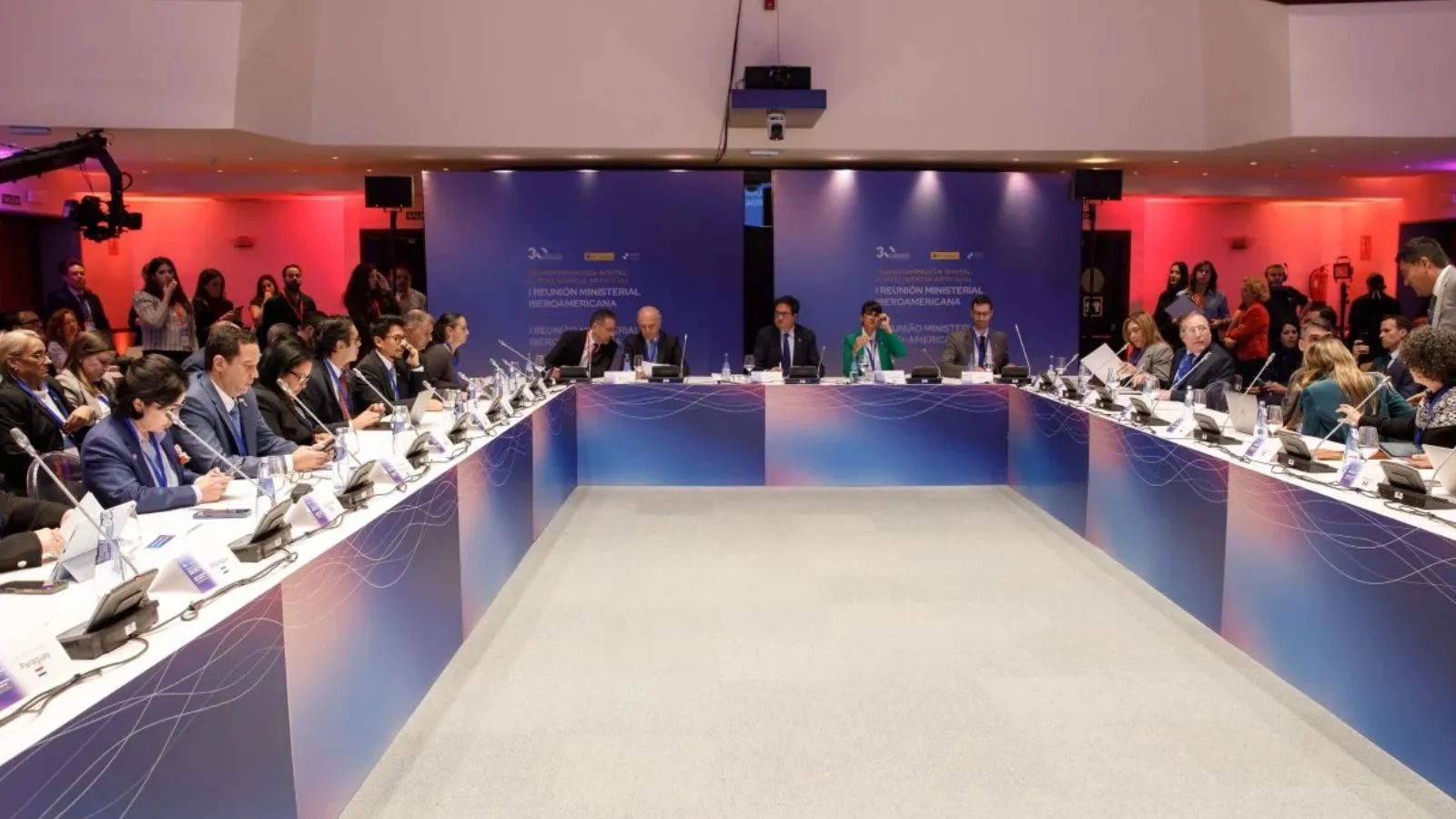

At the first Ibero-American ministerial meeting on digital transformation and AI, it was agreed to create the Ibero-American AI Alliance, which will be presented to the Summit of Heads of State in Madrid on November 4 and 5.
Membership is voluntary and requires a public contribution, either financial or in kind. It rests on three pillars: a federated Ibero-American data space, in which each country decides what it shares; AI models in Spanish, Portuguese and Indigenous languages, building on ALIA (Spain), AMALIA (Portugal), LATAM GPT (Chile) and SoberanIA (Brazil); and cooperation on computing capacity without creating new regional infrastructure. The “Madrid Declaration” on digital rights was also signed.
Ibero-American countries agreed on Tuesday in Madrid to create the Ibero-American Artificial Intelligence Alliance, a regional agreement that seeks to strengthen Ibero-American digital and cultural sovereignty and will make it possible to build a common agenda on Artificial Intelligence (AI). The document will be submitted for adoption to the 30th Ibero-American Summit of Heads of State and Government, which will take place on November 4 and 5 in the Spanish capital. The Alliance will thus be open, on a voluntary basis, to membership by the Member States of the Ibero-American Conference.
The approved Alliance will be structured around three pillars: cooperation on access to quality data, respecting the rules and control of each country; the development of artificial intelligence models adapted to Ibero-American languages and needs; and collaboration on computing capacity to support useful applications for researchers, public administrations and businesses.
The Alliance will thus support the creation of an Ibero-American Data Space for the development of AI systems of public interest for the region. To the extent that these systems rely on data, corpora, categories, public documentation and knowledge sources representative of the region’s own priorities, languages, cultural contexts and social realities, they will better respond to its needs. This regional data ecosystem is not conceived as a single regional database, but as a federated space where each country decides what information it shares and under what conditions.
An AI trained in Ibero-American languages
The Alliance will also promote collaboration in the development of language models and AI systems, in order to improve the representation of Spanish, Portuguese, other official languages and Indigenous languages in the use cases deployed in the region for public administrations, citizens, universities, research centers, businesses and the productive sector.
To this end, work will be done on a shared technological foundation that allows countries to develop their own national, linguistic, sectoral and use-case adaptations. Previous Ibero-American initiatives in language models, public assistants, linguistic corpora, sectoral solutions and AI services will be leveraged as assets, such as the ALIA family of language models, in Spanish and other official languages, AMALIA, the Portuguese project, LATAM GPT, promoted by Chile, and Brazil’s SoberanIA, among others.
Finally, the Alliance includes a line of cooperation on access to computing capacity to develop AI projects. The aim is to organize available resources, connect supply and demand, and develop collaboration mechanisms, without the need to create new regional infrastructure.
This Alliance is the main digital outcome of the Ibero-American Summit, and all Ibero-American countries may join it voluntarily, which will involve active participation, shared responsibility and a public contribution, which may be financial or in kind depending on each country’s circumstances, and which will be regulated through the common governance model.
The Alliance initiative is one of the commitments made by Ibero-American countries in the Madrid Declaration, signed at the ministerial meeting. It sets out a shared vision of the challenges posed by AI and computing in terms of rights, sustainability, inclusion, security and privacy, as well as the enormous opportunities it offers in sectors such as health and education.
A sustainable and responsible AI, at the service of people
In this declaration, the countries agree to “put people at the center,” so that “the rights and freedoms recognized in the analog world” are “also respected in digital environments.” They also commit to adopting AI in a “sustainable and responsible” way, promoting cybersecurity and age-appropriate, bias-free digital environments.
In short, the countries seek to ensure that the development and use of AI is “at the service of people,” respecting human rights and fundamental freedoms. An objective, they add, that is not at odds with innovation, but is rather a “complementary” condition to “build trust” in AI and “expand its economic and social benefits.”
Likewise, during the meeting, the countries validated the Ibero-American Standards for Data Protection and for Identification and Interoperability in Digital Government Services, drawn up by the Ibero-American Data Protection Network and the Latin American Center for Development Administration (CLAD). These are non-binding reference frameworks that offer concrete guidance for their application, with full respect for each country’s legal frameworks and national priorities.
After the meeting, both the Minister for Digital Transformation and Public Service, Óscar López, host of the event, and the Ibero-American Secretary General, Andrés Allamand, assessed the agreements reached at a press conference.
“Today, Ibero-America is committing to a sovereign, ethical, open and trustworthy AI. With the Madrid Declaration and the Alliance, we are proposing a people-centered AI that respects human rights and is safe, responsible and inclusive. An AI at the service of the more than 700 million people who live in Ibero-America,” stressed Minister Óscar López.
“In Ibero-America we want to build a sovereign position that allows us to decide on the technologies to be used without impositions; that helps us understand the criteria and guidelines under which they operate; that makes it possible to adapt them to our needs; that helps us take advantage of their benefits and minimize the risks; and that ensures our participation in defining the rules that will shape their development,” said the Ibero-American Secretary General, Andrés Allamand.
These agreements are part of the efforts to implement the Ibero-American Charter of Principles and Rights in Digital Environments (CIPDED), whose work the Ministerial Meeting has decided to continue promoting. Along the same lines, the Real Fábrica de Moneda y Timbre hosted the Ibero-American Digital Forum in the morning, which featured global leaders in digital rights, cybersecurity and digital governance, as well as senior representatives of Ibero-American countries responsible for digital transformation.
Four talks and four panels discussed and analyzed the main issues related to digital transformation: digital rights and child protection, connectivity and cybersecurity, digital administration, and Artificial Intelligence.
Get the best of the week in your inbox
Every Monday: the most-read stories on Territorio Blockchain, the new podcast episode and news about our events. Free, no spam.
We will send you an email to confirm. You can unsubscribe at any time with the link in every newsletter. Privacy