














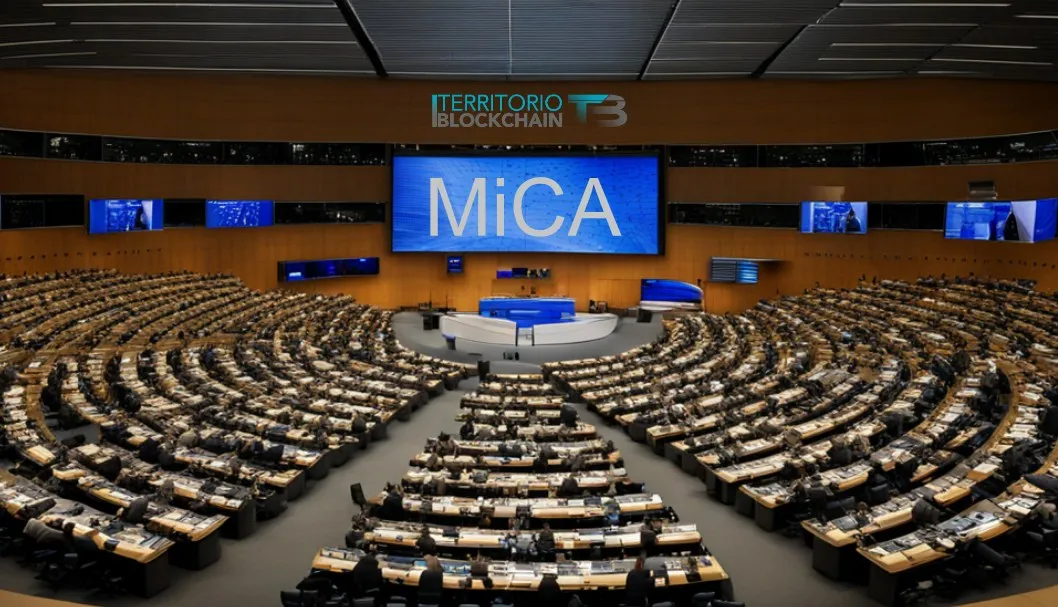

Since 1 July 2026, only firms authorised under MiCA, the European crypto-asset regulation, can offer cryptocurrency services in Spain. This guide explains what it is, which dates define it, how it protects you as a user, what it leaves out and what is currently under review in Brussels.
Updated on 13 November 2026
Think of the complaints form that any bar in Spain has to give you if you ask for it. Before MiCA, a cryptocurrency platform operated in Spain like a bar open for business without showing its kitchen: it signed up to a Banco de España register which, according to the supervisor itself, only looked at anti-money laundering and the good repute of its managers, not at its solvency or how it treated customers.
MiCA is Regulation (EU) 2023/1114 of the European Parliament and of the Council of 31 May 2023 on markets in crypto-assets: the rule that sets out what must be complied with across the European Union by those who issue crypto-assets, offer them to the public or provide services involving them, such as exchanges, custodians or advisers. Among other things, it requires these firms to have their own complaints form. The official text is available on EUR-Lex.
What MiCA is and who approved it
The European Parliament and the Council of the EU signed the regulation on 31 May 2023. It was published in the Official Journal of the European Union (OJ L 150) on 9 June 2023 and entered into force twenty days later, on 29 June 2023. As a regulation, it applies directly in all 27 countries without the need for a national law to transpose it.
It distinguishes between stablecoins pegged to a single official currency, which the text calls “e-money tokens” (EMTs), those backed by a basket of assets, “asset-referenced tokens” (ARTs), and all other crypto-assets, from bitcoin to utility tokens. It also regulates crypto-asset service providers, or CASPs (the CNMV uses the Spanish acronym PSC).
In Spain, the CNMV authorises and supervises providers and those offering crypto-assets other than stablecoins; the Banco de España supervises issuers of EMTs and ARTs. ESMA and the European Banking Authority (EBA) coordinate the national supervisors and maintain the common registers.
MiCA timeline: all the key dates
Stablecoins came first, six months ahead of everything else. Each country could also grant a transitional period of up to 18 months to firms that were already operating (Article 143(3)). Spain did not shorten it: according to the CNMV, it ended on 1 July 2026.
| Date | What happens | Who is affected |
|---|---|---|
| 31 May 2023 | Signing of Regulation (EU) 2023/1114 | European Parliament and Council |
| 29 June 2023 | Entry into force (20 days after its publication in the OJ on 9 June) | The whole sector, with no obligations yet |
| 30 June 2024 | Titles III and IV apply: EMT and ART stablecoins | Stablecoin issuers; in Spain, supervised by the Banco de España |
| 30 December 2024 | Full application of MiCA and the travel rule (Regulation (EU) 2023/1113) | Exchanges, custodians, issuers and offerors of crypto-assets |
| 1 July 2026 | End of the transitional period in Spain; the Banco de España closes its old register | Platforms operating without a MiCA licence |
| 30 June 2027 | Deadline for the Commission’s final report on the application of MiCA (Article 140) | European Commission, with the EBA and ESMA |
| 31 December 2027 | Platforms must have published the white paper for crypto-assets already trading before 30 December 2024 (Article 143(2)) | Trading platform operators |
When 1 July 2026 arrived, the Banco de España closed the register of virtual currency exchange and custodial wallet providers required under Law 10/2010 on the prevention of money laundering. Its data can still be consulted, but only as a historical record. If your platform boasts of being “registered with the Banco de España”, that no longer allows it to operate today.
What changes for you as a user
The first thing is who can serve you. Since 1 July 2026, only providers authorised by the CNMV or another European authority can provide services in Spain. With the European passport (Article 65), a firm authorised in France or Malta can operate in Spain if it notifies its supervisor, and can start no later than fifteen calendar days afterwards.
The CNMV publishes the list of providers authorised for Spain. On 13 November 2026 it included around 200 entities, among them banks such as BBVA, CaixaBank, ABANCA and Renta 4 and Spanish firms such as Bitcoinforme, S.L. and Criptan Trade, S.L. The EU-wide register is maintained by ESMA. We explain how to read these two lists in How to check whether your exchange has a MiCA licence.
In addition, the authorised firm owes you the following:
- To act honestly and in your best interest, and to give you clear, non-misleading information, including in its advertising (Article 66).
- To keep your cryptocurrencies and your money separate from its own, so that it cannot use them for its own account and they are protected if it goes bankrupt (Article 70).
- To have a free complaints procedure, with a template for filing complaints, a record of all those received and a response within a reasonable time (Article 71).
If you buy a new crypto-asset in its public offering, the issuer must have notified a white paper (white paper) to its supervisor, although the CNMV points out that notification does not mean it has approved it. For such direct purchases from the offeror, you have 14 calendar days to withdraw at no cost and without giving reasons (Article 13). This right does not cover buying and selling bitcoin or ether on an exchange.
Since 30 December 2024, transfers between providers have also travelled with the details of the sender and the recipient (the travel rule, Regulation (EU) 2023/1113). That is why your exchange may ask you for the recipient’s details before letting you withdraw.
Two limits. MiCA does not create a guarantee fund like the one for bank deposits: if a platform goes bankrupt, you are protected by the segregation of assets. And the CNMV’s Complaints Service does not yet handle complaints about crypto-assets; the CNMV has a draft circular to include them under public consultation from 15 October to 16 November 2026, as we reported in this news story on the CNMV’s Complaints Service.
What changes for firms
Providing services requires authorisation as a crypto-asset service provider (Article 59). In Spain, it is requested from the CNMV, which has 25 working days to check that the application is complete and a further 40 working days, from the time it is complete, to decide (Article 63). Banks, investment firms and other already authorised financial institutions can use a shorter procedure: a prior notification (Article 60).
The minimum capital depends on what the firm does (Annex IV): €50,000 for advising, managing portfolios or transmitting orders; €125,000 if it also provides custody or exchanges crypto-assets for money or for other crypto-assets; and €150,000 if it operates a trading platform. If a quarter of its annual fixed overheads is higher, that figure applies (Article 67).
According to clarifications the CNMV issued in June 2026, platforms that failed to obtain a licence must offer their customers a migration plan to return their crypto-assets and money or transfer them to an authorised provider.
For readers in Latin America: MiCA does not regulate an exchange in Bogotá or Panama City that serves customers in its own country. It is affected if it wants to attract customers in the EU, because without a licence it can only serve a European resident when the initiative has come exclusively from that customer (Article 61).
What MiCA does not cover
- Unique NFTs. Article 2(3) excludes crypto-assets that are “unique and not fungible”, such as digital art. Note: according to Recital 11, issuing them “in a large series or collection” indicates that they are fungible.
- Fully decentralised DeFi. According to Recital 22, services provided “in a fully decentralised manner without any intermediary” fall outside its scope. If there is a company behind it that controls the service, it is covered.
- Central bank currencies. The ECB and national central banks, when acting as monetary authorities, are excluded (Article 2(2)). The digital euro is governed by its own rules.
- Tokenised securities. A share or a bond in token form remains a financial instrument (Article 2(4)) and falls under MiFID II and the distributed ledger technology (DLT) pilot regime. That is the case of the tokenised securities market authorised by the CNMV. For real estate, see Real estate tokenisation in Spain: what is legal today.
What remains pending as of November 2026
MiCA is already under review. In 2026 the European Commission opened two consultations, one for the industry and another for the public, linked to two mandates in the regulation: the report on what MiCA does not cover (DeFi, lending, NFTs), which Article 142 set for 30 December 2024, and the final report on its application, due on 30 June 2027 (Article 140). On 27 October 2026, Commissioner Maria Luís Albuquerque also opened a dialogue on where MiCA could be simplified.
The most far-reaching change is taking a different route. On 4 December 2025 the Commission proposed that ESMA directly supervise crypto-asset service providers. On 9 October 2026 the Council agreed on the key elements of its position, which limits that supervision to the most significant cross-border providers. It still has to go through the European Parliament and the final negotiations, so for now the CNMV continues to grant authorisations in Spain.
On stablecoins, the EBA has supervised USDC since 12 November 2026, the first e-money token declared significant. We cover what happens to stablecoins without authorisation in the EU in Stablecoins and MiCA: EMTs, ARTs and what happens to USDT.
Frequently asked questions
Does my exchange have to be authorised by the CNMV?
Not necessarily by the CNMV, but it must be by an EU authority. A firm authorised in another country can operate in Spain with the European passport. Check the CNMV list and the ESMA register.
What happens to my cryptocurrencies if the platform does not have a MiCA licence?
Since 1 July 2026 it cannot provide you with services in Spain and must offer you a plan to withdraw or transfer your funds. The CNMV warns that if you keep using it, you will not have MiCA’s protection.
Does MiCA guarantee my money like a bank deposit?
No. MiCA has no guarantee fund. It requires your assets to be kept separate from the firm’s, but if the price falls, nobody covers that loss.
Does MiCA affect users in Latin America?
Not someone who lives in Latin America and uses a local exchange. It does affect that exchange if it wants to attract customers in the EU: it needs a MiCA licence.
Where do I complain if I have a problem with an exchange?
To the provider’s own complaints service, which is free by law. The CNMV is preparing a circular to also handle crypto-asset complaints, but it has not yet been approved.
Back to the bar. MiCA does not stop the coffee from being bad, or bitcoin from dropping 30% in a month, but it does tell you who is licensed to serve it, which kitchen has been inspected and where the complaints form is. Before you move a single euro, have you checked which list your platform appears on?
This content is for information purposes only and is not investment advice.
{ “@context”: “https://schema.org”, “@type”: “FAQPage”, “mainEntity”: [ { “@type”: “Question”, “name”: “¿Mi exchange tiene que estar autorizado por la CNMV?”, “acceptedAnswer”: { “@type”: “Answer”, “text”: “No necesariamente por la CNMV, pero sí por alguna autoridad de la UE. Una empresa autorizada en otro país puede operar en España con el pasaporte europeo. Compruébalo en el listado de la CNMV y en el registro de ESMA.” } }, { “@type”: “Question”, “name”: “¿Qué pasa con mis criptomonedas si la plataforma no tiene licencia MiCA?”, “acceptedAnswer”: { “@type”: “Answer”, “text”: “Desde el 1 de julio de 2026 no puede prestarte servicios en España y debe ofrecerte un plan para retirar o traspasar tus fondos. La CNMV advierte de que, si sigues operando con ella, no tendrás la protección de MiCA.” } }, { “@type”: “Question”, “name”: “¿MiCA garantiza mi dinero como un depósito bancario?”, “acceptedAnswer”: { “@type”: “Answer”, “text”: “No. MiCA no tiene fondo de garantía. Obliga a separar tus activos de los de la empresa, pero si el precio cae, esa pérdida no la cubre nadie.” } }, { “@type”: “Question”, “name”: “¿Afecta MiCA a los usuarios de América Latina?”, “acceptedAnswer”: { “@type”: “Answer”, “text”: “A quien vive en América Latina y usa un exchange local, no. Sí afecta a ese exchange si quiere captar clientes en la UE: necesita licencia MiCA.” } }, { “@type”: “Question”, “name”: “¿Dónde reclamo si tengo un problema con un exchange?”, “acceptedAnswer”: { “@type”: “Answer”, “text”: “En el servicio de reclamaciones del propio proveedor, gratuito por ley. La CNMV prepara una circular para atender también las de criptoactivos, pero aún no está aprobada.” } } ] }
Get the best of the week in your inbox
Every Monday: the most-read stories on Territorio Blockchain, the new podcast episode and news about our events. Free, no spam.
We will send you an email to confirm. You can unsubscribe at any time with the link in every newsletter. Privacy