
















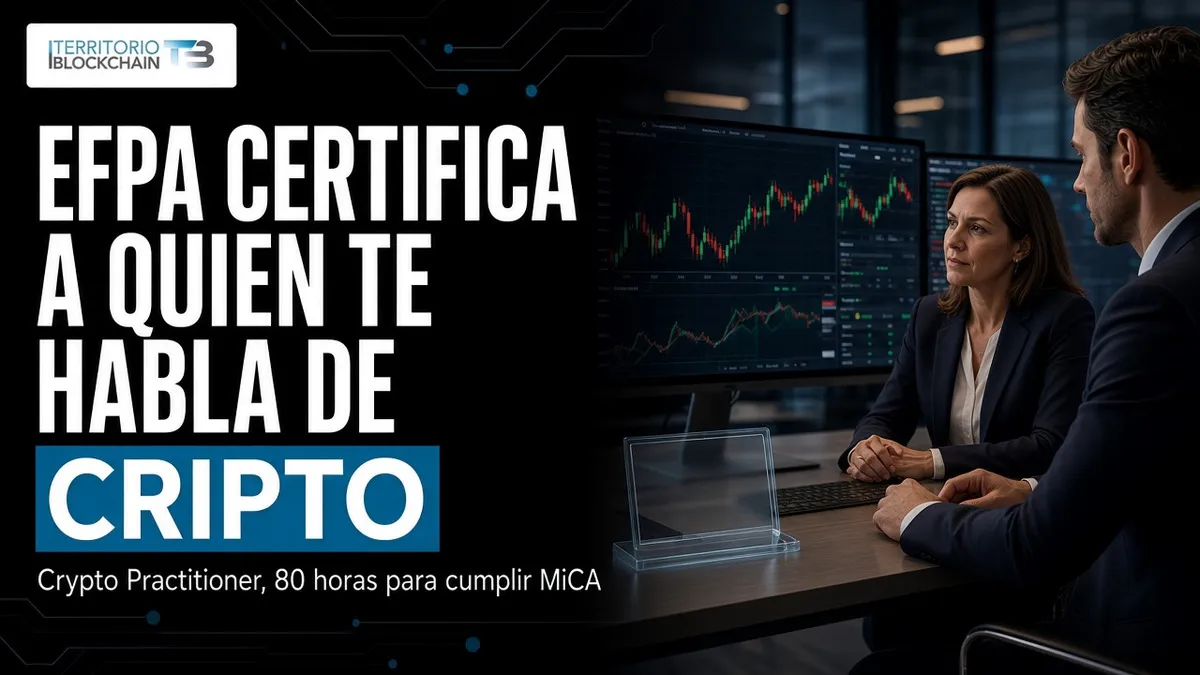

EFPA Spain presented EFPA Crypto Practitioner on Tuesday, November 24, a MiCA-linked crypto certification that attests that whoever informs you about crypto-assets on behalf of a company knows what they are talking about. The training is already available and the first exams will be held in March 2027.
Think about the last time you wrote to an exchange’s support team or asked your bank about a bitcoin-linked product. Did the person who answered know what a private key is? Until recently, nobody checked. Since this summer there are European criteria for doing so, and the EFPA certification is one way of meeting them.
What MiCA requires of those who provide information on crypto-assets
Article 81 of Regulation (EU) 2023/1114, known as MiCA, requires crypto-asset service providers to ensure that staff who inform or advise clients have the necessary knowledge and competence. Put that way it sounds generic, which is why the European Securities and Markets Authority (ESMA) spelled it out in guidelines on knowledge and competence, published in all official languages on January 28, 2026. They apply from July 28, 2026.
In Spain, the CNMV announced in a statement on March 30, 2026 that it complies with these guidelines and will apply their criteria in its supervision, something also reflected in the compliance table published by ESMA. It also coincides with the end of the transitional period, because since July 1, 2026 only providers authorised by the CNMV or another European authority can operate in Spain, as explained on the CNMV’s MiCA page (if you have doubts about yours, here we explain how to check whether your exchange has a MiCA licence).
The guidelines distinguish two profiles. On one side are those who provide information, explaining how a product works, what it costs and what risks it carries. On the other are those who advise and recommend what you should do based on your situation. Considerably more is asked of the latter.
The 80 hours of EFPA’s MiCA crypto certification
This is the crux of it. For staff who provide information, ESMA sets as the main route a professional qualification of at least 80 hours, accompanied by six months of supervised experience, and gives 10 hours as an example of annual continuing education. The EFPA Crypto Practitioner programme lasts exactly 80 hours and requires holders to complete 10 hours of continuing education a year. EFPA has tailored the suit to fit the rule.
The syllabus follows the same line. It consists of eight 100% online modules covering blockchain and distributed ledger technology (DLT), types of crypto-assets, how their markets work, their risks and costs, and the European regulatory framework. Added to that are anti-money laundering and counter-terrorist financing, market abuse, professional ethics and the line between informing and advising. If you lack the basics, our Academy explains what blockchain is.
To put it simply, a certified professional should be able to explain what happens if you store your wallet’s private keys poorly and why the protection MiCA gives you is not the same as that of an investment product regulated by MiFID II. Both items appear explicitly in ESMA’s list of knowledge, alongside volatility, cyberattacks, software failures and transfer risks.
Who it is for and how to obtain it
It is designed mainly for employees of crypto-asset service providers (CASPs) and other financial institutions who provide information on these assets, although any candidate who meets the entry requirements can apply. No other EFPA certification is needed, and you can take the course and the exam or go straight to the test. According to the certification page on EFPA’s website, the exam has 40 multiple-choice questions with four options, lasts an hour and a half and requires 28 correct answers to pass (70%), with no penalty for wrong answers. Non-members also pay an annual fee of 85 euros. The website does not publish the price of the exam.
The content has been approved by EFPA Europe. The exam is designed and administered by EFPA Spain, which issues the certificate and maintains a register of valid certificates. Those who obtain it will also have to comply with the association’s code of ethics. Verónica Martín, head of Accreditation and Certification at EFPA Spain, maintains that “clear and rigorous information is essential to strengthen client trust.”
What you should know before signing up
The core of the matter is that the certification helps, but it is not mandatory. ESMA’s guidelines allow another route, one year of supervised experience, and consider competent anyone who had already been providing information on crypto-assets full-time for at least a year before they came into force. Staff who do not yet meet the requirements can work under the supervision of a qualified person for a maximum of four years. In other words, a company can comply with MiCA without any of its employees going through EFPA.
The timing also surprises me. The guidelines apply from July 2026 and the first exam arrives in March 2027, eight months later. Until then, firms wishing to use this certification will have to rely on supervision or on their staff’s prior experience.
The certification’s value lies elsewhere. The assessment is carried out by a third party, with an exam, a register and annual recertification, something that carries more weight with a supervisor than an in-house course. EFPA knows the terrain well, as it took part in ESMA’s public consultation on these guidelines and called for a clear framework of qualification requirements. And it carries weight in the sector, with more than 36,600 certified members in Spain, which according to the association itself account for more than a third of Europe’s certified advisers.
The next step, EFPA Crypto Advisor
The association is preparing a higher-level certification, EFPA Crypto Advisor, for those who provide personalised advice and must assess whether a crypto-asset suits a specific client. There the bar rises. For advising, ESMA requires, for example, training of at least 160 hours or a related university degree, always with one year of supervised experience, and sets 20 hours of annual continuing education as a benchmark. EFPA has not yet given dates or a duration for this second programme.
In addition, EFPA has added three micro-credentials, in sustainability (ESG Fundamentals), European crypto-asset regulation (MiCA) and artificial intelligence applied to financial advice. The association itself clarifies that they neither replace nor are equivalent to a professional certification such as Crypto Practitioner. If you want to review exactly what the regulation covers, see MiCA explained, what changes for you.
Let’s go back to the person who helps you at your exchange’s support desk. Since this summer they must be able to show they can explain the risks of what they offer you, and from March they will have one more way of doing so, with a stamp on their CV. Would you ask about their certification before trusting their explanation?
Get the best of the week in your inbox
Every Monday: the most-read stories on Territorio Blockchain, the new podcast episode and news about our events. Free, no spam.
We will send you an email to confirm. You can unsubscribe at any time with the link in every newsletter. Privacy